Key Takeaways
- AI is improving diagnosis, treatment planning, and clinical decision-making.
- Predictive analytics can support earlier identification of healthcare risks.
- AI-powered automation can reduce repetitive administrative workloads.
- Virtual healthcare can improve access to specialist services.
- Personalized healthcare can make treatment more patient-centric.
- AI adoption is expected to grow alongside Saudi Arabia’s digital-health transformation.
Artificial Intelligence (AI) is rapidly changing how healthcare is delivered, managed, and experienced across Saudi Arabia. From intelligent diagnostics and predictive analytics to virtual healthcare and personalized treatment, AI in healthcare providers make faster, data-driven decisions while improving patient experiences.
This transformation aligns closely with Saudi Vision 2030, which identifies digital transformation as an important driver of a more efficient, accessible, and patient-focused healthcare system. Saudi Arabia’s Ministry of Health is already advancing electronic health records, health information exchange, telemedicine, cloud computing, AI, IoT, and other digital technologies as part of its healthcare transformation strategy.
AI can analyze large volumes of medical data, identify patterns, support clinicians, automate administrative processes, and help healthcare organizations predict potential risks. As healthcare providers continue adopting intelligent technologies, AI is moving from an emerging innovation to an important component of modern healthcare infrastructure. For hospitals, clinics, pharmaceutical organizations, diagnostic centers, insurers, and health-tech startups, this creates significant opportunities to build smarter healthcare solutions tailored to the needs of Saudi patients and providers.
The Saudi Arabia AI in healthcare market is projected to reach USD 638.11 million by 2034, growing at a compound annual growth rate (CAGR) of 24.70% from 2026 to 2034.
This growth reflects increasing interest in AI-powered diagnostics, predictive analytics, virtual healthcare, medical imaging, patient monitoring, automation, and personalized medicine. Saudi Arabia is also developing digital infrastructure and innovation initiatives that can support the testing and deployment of emerging healthcare technologies.
Further, the Ministry of Health reported that its Sandbox initiative had supported 342 innovative solutions, including projects involving digital health, AI, IoT, biotechnology, and 3D printing.
The market opportunity therefore extends beyond simply implementing AI-powered heathcare software. Healthcare organizations can use AI to redesign workflows, improve data utilization, strengthen patient engagement, and create more proactive models of care.
Benefits of AI in Saudi Healthcare: Creating Faster, Smarter, Patient-Centric Care
AI can deliver value across clinical, operational, and patient-facing areas of healthcare. By combining medical data with intelligent algorithms, healthcare organizations can improve decision-making while reducing repetitive workloads. The result can be a more connected healthcare ecosystem that supports better accessibility, efficiency, personalization, and continuity of care.
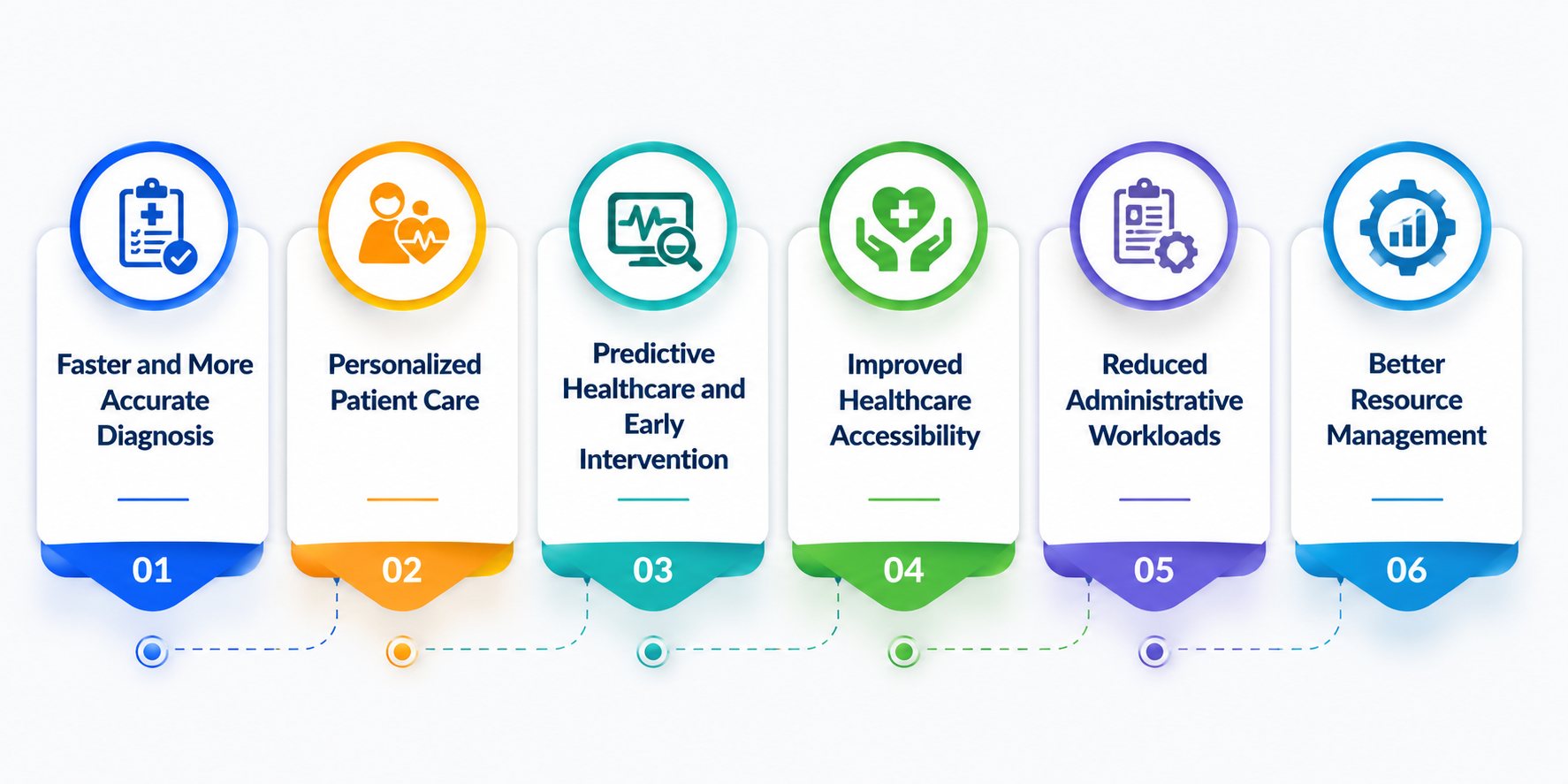
1. Faster and More Accurate Diagnosis
AI can analyze medical images, laboratory information, patient histories, and other clinical data to identify patterns that may require attention. It can assist healthcare professionals in detecting potential abnormalities and prioritizing cases. AI is not a replacement for clinical expertise, instead, it can provide additional decision-support capabilities.
- Medical image analysis
- Pattern recognition
- Clinical decision support
- Diagnostic prioritization
2. Personalized Patient Care
AI can help healthcare providers understand individual patient characteristics and historical health information to support more personalized care strategies. Instead of relying only on generalized treatment pathways, clinicians can use intelligent insights to consider patient-specific factors and develop more informed care plans.
- Patient-specific insights
- Personalized treatment support
- Health-risk assessment
- Continuous care optimization
3. Predictive Healthcare and Early Intervention
Predictive analytics can examine historical and real-time information to identify potential health risks before they become more serious. Hospitals can use these insights to support preventive care, monitor high-risk patients, and allocate resources more effectively, moving healthcare from a reactive model toward a more proactive approach.
- Risk prediction
- Early intervention
- Patient monitoring
- Preventive healthcare
4. Improved Healthcare Accessibility
AI-powered digital platforms can help extend healthcare services beyond traditional hospital environments. Combined with telemedicine and virtual-care infrastructure, intelligent systems can support remote consultations, patient monitoring, triage, and access to specialist knowledge. Saudi Arabia’s digital-health strategy emphasizes remote consultation and interconnected healthcare services.
- Remote healthcare access
- Virtual consultations
- Digital triage
- Specialist support
5. Reduced Administrative Workloads
Healthcare professionals often spend considerable time managing documentation, scheduling, records, billing, and other repetitive activities. AI can automate or assist with selected administrative workflows, allowing healthcare teams to dedicate more time to patient-facing responsibilities and clinical activities.
- Automated documentation
- Smart scheduling
- Workflow automation
- Administrative assistance
6. Better Resource Management
AI can help healthcare organizations analyze patient volumes, staffing requirements, equipment utilization, and operational patterns. These insights can support more efficient planning and resource allocation, helping hospitals respond to changing demand while improving operational visibility.
- Capacity forecasting
- Staff planning
- Equipment optimization
- Demand prediction
Essential AI Features Powering Saudi Arabia’s Healthcare Transformation
AI healthcare solutions are becoming increasingly sophisticated, combining machine learning, natural language processing, computer vision, predictive analytics, automation, and connected data systems. These capabilities can be integrated into hospital platforms, healthcare applications, diagnostic systems, patient portals, and enterprise healthcare software to create intelligent and scalable digital ecosystems.
1. AI-Powered Medical Imaging
Computer vision and machine learning can analyze medical images such as X-rays, CT scans, and MRI images to identify patterns that may require professional review. Such systems can support radiologists and clinicians by helping prioritize cases and providing additional analytical insights.
2. Predictive Analytics
Predictive AI analyzes historical and current healthcare information to estimate potential outcomes or risks. Healthcare organizations can use it for patient deterioration alerts, readmission-risk assessment, demand forecasting, population-health analysis, and operational planning.
3. Intelligent Virtual Assistants
AI-powered virtual assistants can interact with patients through digital healthcare platforms. They can answer general questions, provide appointment-related assistance, guide users through services, and support basic healthcare workflows while escalating appropriate matters to human professionals.
4. Natural Language Processing
Natural Language Processing (NLP) enables AI systems to understand and process human language. In healthcare, NLP can assist with medical documentation, information extraction, clinical notes, patient communications, and information retrieval, helping organizations make better use of unstructured healthcare data.
5. Remote Patient Monitoring
AI can work alongside connected devices and digital monitoring platforms to analyze patient information remotely. Intelligent systems can identify unusual patterns and generate alerts for healthcare teams, supporting continuous monitoring for patients who require ongoing supervision.
6. AI-Based Clinical Decision Support
Clinical decision-support systems can combine patient information with medical knowledge and analytical models to provide relevant insights to healthcare professionals. These systems can help clinicians review information more efficiently while keeping medical decisions under appropriate professional oversight.
Emerging AI Healthcare Trends Shaping Saudi Arabia’s Digital Health Ecosystem
Saudi Arabia’s healthcare transformation is moving toward connected, preventive, personalized, and technology-enabled models of care. AI is becoming part of this wider ecosystem rather than operating as a standalone technology. The Kingdom’s digital-health plans specifically identify AI alongside IoT, smart devices, cloud computing, telemedicine, and health information systems.
1. AI-Powered Preventive Healthcare
Healthcare is increasingly shifting from treating illness after it occurs toward preventing health problems through early detection and continuous monitoring. AI can analyze population and patient data to identify risk patterns, helping providers develop more proactive healthcare strategies.
2. Virtual Hospitals and Intelligent Telemedicine
Virtual healthcare is becoming an important part of healthcare accessibility. Saudi Arabia’s digital-health ecosystem includes virtual-care initiatives designed to connect patients with medical expertise remotely. AI can strengthen these models through intelligent triage, patient monitoring, decision support, and workflow automation.
3. Generative AI in Healthcare
Generative AI can support healthcare organizations with tasks such as summarizing information, generating drafts of documentation, assisting communication, and enabling conversational interfaces. Its use requires strong governance, privacy controls, validation, and human oversight because healthcare decisions demand high levels of accuracy and accountability.
4. AI and IoT-Based Patient Monitoring
The combination of AI and IoT can create connected healthcare environments in which devices continuously generate information. AI can analyze this information to identify patterns, support alerts, and provide healthcare professionals with a more comprehensive view of patient conditions.
5. AI-Driven Drug Discovery
AI can accelerate research by helping researchers analyze biological datasets, identify potential drug candidates, model molecular interactions, and explore new therapeutic possibilities. As Saudi Arabia develops its life-sciences and biotechnology ecosystem, AI can become an important research-enablement technology.
6. Intelligent Healthcare Automation
AI-powered automation is increasingly being applied beyond clinical environments. Scheduling, patient communication, claims processing, documentation, data entry, reporting, and other workflows can be enhanced through intelligent automation, helping organizations improve efficiency while reducing repetitive manual processes.
The Future of AI in Saudi Healthcare: From Digital Transformation to Intelligent Care
The future of AI in Saudi healthcare will likely involve deeper integration between artificial intelligence, electronic health records, cloud platforms, IoT devices, telemedicine, robotics, genomics, and connected healthcare applications. Rather than using AI for isolated tasks, healthcare organizations can increasingly build interconnected intelligent ecosystems around the patient.
Saudi Arabia’s Ministry of Health aims to develop interconnected health information systems and a unified electronic health record environment, creating an important foundation for data-driven healthcare.
Future AI systems may support more advanced predictive healthcare, personalized treatment recommendations, intelligent medical imaging, automated clinical documentation, real-time patient monitoring, and population-health management.
At the same time, responsible AI will become increasingly important. Healthcare organizations will need strong data governance, cybersecurity, privacy protection, model validation, interoperability, transparency, and human oversight. AI should enhance medical expertise rather than replace it.
As Saudi Arabia continues implementing Vision 2030 and investing in digital transformation, organizations that combine healthcare expertise with secure and scalable AI technologies will be better positioned to create meaningful healthcare innovations.
Conclusion
The healthcare industry is entering an intelligent transformation, and Saudi Arabia is creating a strong environment for digital innovation. From predictive analytics and intelligent diagnostics to virtual care and automated workflows, AI can help healthcare organizations deliver more connected, efficient, and personalized services.
At ToXSL Technologies, we help businesses and healthcare organizations transform innovative ideas into scalable digital solutions using AI, machine learning, automation, cloud technologies, and modern application development.
Whether you are planning an AI-powered healthcare application, intelligent patient platform, predictive analytics solution, virtual healthcare system, or custom AI ecosystem, the right technology strategy can help turn your vision into a practical digital solution. Ready to build smarter healthcare solutions for Saudi Arabia? Partner with ToXSL Technologies and explore the possibilities of AI-powered healthcare innovation.
Frequently Asked Questions
1. How is AI transforming healthcare in Saudi Arabia?
AI is transforming healthcare by supporting intelligent diagnosis, predictive analytics, personalized care, virtual healthcare, patient monitoring, clinical decision support, and administrative automation. These capabilities can help healthcare organizations improve efficiency, accessibility, and patient experiences.
2. What are the main benefits of AI in Saudi healthcare?
Major benefits include faster analysis of healthcare data, improved clinical decision support, personalized care, predictive risk assessment, better resource management, reduced administrative workloads, and improved access to healthcare services.
3. What AI technologies are used in healthcare?
Healthcare AI commonly uses machine learning, deep learning, natural language processing, computer vision, predictive analytics, generative AI, conversational AI, and intelligent automation. These technologies can be integrated into healthcare applications, hospital systems, diagnostic platforms, and patient-monitoring solutions.
4. How does AI support personalized healthcare?
AI can analyze patient information and identify patterns across health records, clinical data, and other relevant information. These insights can help healthcare professionals better understand individual patient needs and support more personalized care strategies.
5. What is the future of AI in Saudi healthcare?
The future is expected to involve deeper integration of AI with electronic health records, IoT, telemedicine, cloud computing, medical imaging, genomics, biotechnology, and connected healthcare platforms. Responsible AI governance and human oversight will remain essential.
6. Why is Saudi Arabia investing in AI-powered healthcare?
AI supports Saudi Arabia’s broader digital-health and Vision 2030 transformation objectives. The Ministry of Health identifies modern technologies such as AI, IoT, cloud computing, telemedicine, and connected health information systems as important components of healthcare modernization.