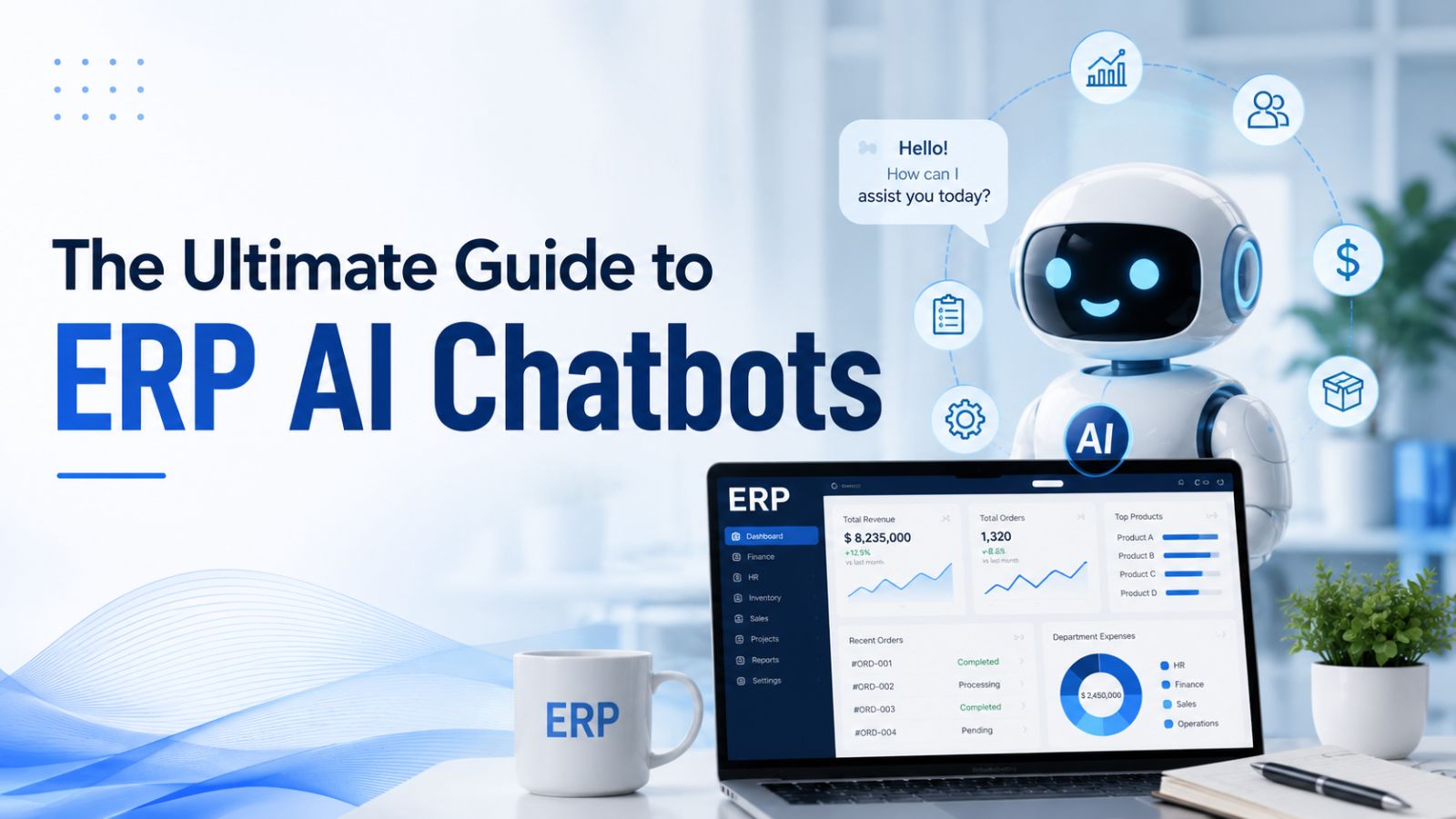
Artificial Intelligence (AI) is transforming enterprise resource planning (ERP) systems by introducing intelligent automation, real-time insights, and conversational support through AI-powered chatbots. Businesses across industries are adopting ERP AI chatbots to streamline workflows, improve employee productivity, and enhance customer experiences. These intelligent virtual assistants can automate repetitive tasks, provide instant access to business data, and simplify complex ERP processes.
As organizations continue their digital transformation journey, ERP AI chatbots are becoming a strategic investment for improving operational efficiency, reducing costs, and enabling smarter business decisions. Companies in Dubai and across the Middle East are increasingly leveraging these solutions to stay competitive.
AI in ERP Market Statistics
The Global AI in ERP Market is expected to reach USD 46.5 Billion by 2033, growing at a CAGR of 26.30% during the forecast period from 2024 to 2033. This remarkable growth highlights the increasing adoption of AI-powered ERP solutions as organizations seek to automate business operations, improve decision-making, optimize resource utilization, and enhance customer engagement through intelligent technologies like AI chatbots.
Key Takeaways
- ERP AI chatbots automate routine business processes and improve operational efficiency.
- AI-powered virtual assistants provide instant access to ERP data through natural conversations.
- Businesses can significantly reduce manual workloads and operational costs.
- Intelligent chatbots improve employee productivity by offering 24/7 assistance.
- ERP AI chatbots integrate seamlessly with finance, HR, CRM, inventory, and supply chain modules.
- AI-driven automation enables businesses to make faster, data-driven decisions while enhancing customer satisfaction.
Understanding ERP AI Chatbots in Dubai
As businesses in Dubai accelerate their digital transformation initiatives, ERP AI chatbots are becoming an essential component of modern enterprise management. These intelligent assistants combine Artificial Intelligence (AI), Natural Language Processing (NLP), and Machine Learning (ML) to interact with users, automate repetitive tasks, retrieve ERP data instantly, and simplify enterprise workflows.
Key Benefits of ERP AI Chatbots for Business Growth and Operational Excellence
ERP AI chatbots are transforming the way businesses manage enterprise operations by combining artificial intelligence with enterprise resource planning systems. These intelligent assistants automate repetitive tasks, improve communication, provide instant access to business information, and support faster decision-making.
1. Automates Repetitive Business Processes
ERP AI chatbots eliminate repetitive manual tasks by automating routine business activities such as attendance inquiries, invoice tracking, purchase requests, inventory checks, and report generation. This automation enables employees to focus on strategic initiatives while improving overall operational efficiency.
- Reduces manual workload.
- Increases employee productivity.
- Minimizes process delays.
- Improves workflow consistency.
2. Enhances Employee Productivity
Employees no longer need to navigate multiple ERP modules to find information. AI chatbots instantly retrieve relevant data, answer questions, and execute requests, allowing teams to complete daily tasks more efficiently while reducing dependency on technical support.
- Provides instant ERP assistance.
- Saves valuable working hours.
- Simplifies complex ERP tasks.
- Reduces employee frustration.
3. Delivers Real-Time Business Insights
ERP AI chatbots provide immediate access to critical business data, including sales reports, inventory levels, financial performance, procurement status, and operational analytics. Real-time information enables business leaders to make informed decisions without waiting for manual reporting.
- Accesses live ERP data.
- Generates instant business reports.
- Improves operational visibility.
- Enables data-driven strategies.
4. Reduces Operational Costs
By automating workflows and minimizing manual intervention, ERP AI chatbots help organizations reduce administrative expenses, support costs, and operational inefficiencies. Businesses achieve higher productivity while optimizing resource utilization and lowering overall operational expenditure.
- Minimizes administrative costs.
- Reduces support expenses.
- Optimizes resource utilization.
- Improves business efficiency.
5. Improves Customer Service
ERP AI chatbots respond instantly to customer inquiries regarding orders, invoices, delivery updates, returns, and account information. Quick and accurate responses improve customer satisfaction while reducing response times and support team workloads.
- Provides instant customer support.
- Offers 24/7 service availability.
- Enhances customer satisfaction.
- Reduces support ticket volume.
6. Strengthens Data Accuracy
Manual data entry often leads to errors that affect business performance. ERP AI chatbots retrieve and process information directly from ERP systems, ensuring greater accuracy, consistency, and reliability across enterprise operations.
- Reduces human errors.
- Ensures accurate ERP records.
- Improves data consistency.
- Enhances reporting accuracy.
Different Types of ERP AI Chatbots for Modern Businesses
ERP AI chatbots are available in various types, each designed to address specific business requirements, operational complexities, and automation goals. Choosing the right ERP AI chatbot depends on factors such as business size, industry, ERP infrastructure, and desired level of automation.
1. Rule-Based ERP AI Chatbots
Rule-based ERP AI chatbots operate using predefined rules, workflows, and decision trees. They respond to specific commands and follow structured conversation paths, making them suitable for handling repetitive business tasks and frequently asked questions within ERP systems. These chatbots are easy to deploy and require minimal maintenance.
2. AI-Powered Conversational ERP Chatbots
AI-powered conversational chatbots utilize Artificial Intelligence, Natural Language Processing (NLP), and Machine Learning (ML) to understand user intent and provide intelligent, context-aware responses. They continuously learn from interactions, enabling businesses to automate complex ERP processes while delivering personalized user experiences.
3. Voice-Enabled ERP AI Chatbots
Voice-enabled ERP AI chatbots allow users to interact with enterprise systems through spoken commands instead of text. These chatbots improve accessibility, increase productivity, and support hands-free operations, making them particularly valuable for manufacturing facilities, warehouses, logistics, and field service teams.
4. Hybrid ERP AI Chatbots
Hybrid ERP AI chatbots combine rule-based automation with advanced AI capabilities to deliver intelligent and structured conversations. They efficiently handle both simple requests and complex business scenarios, offering greater flexibility, higher accuracy, and improved automation across multiple ERP modules.
5. Department-Specific ERP AI Chatbots
Department-specific ERP AI chatbots are designed to support individual business functions such as Human Resources, Finance, Procurement, Sales, Inventory, or Customer Support. These chatbots provide specialized assistance, automate departmental workflows, and improve productivity through tailored business intelligence.
ERP AI Chatbot Type | Primary Purpose | Best Suited For | AI Capability | Key Advantages |
|---|---|---|---|---|
Rule-Based ERP Chatbot | Execute predefined workflows | Small businesses, FAQs, routine ERP tasks | Low | Simple implementation, cost-effective, consistent responses |
AI-Powered Conversational Chatbot | Intelligent conversations and automation | Medium to large enterprises | High | Context-aware responses, continuous learning, advanced automation |
Voice-Enabled ERP Chatbot | Voice-controlled ERP operations | Warehouses, manufacturing, field services | High | Hands-free access, faster task execution, improved accessibility |
Hybrid ERP Chatbot | Combine rule-based and AI automation | Growing businesses with diverse workflows | High | Greater flexibility, better accuracy, scalable automation |
Department-Specific ERP Chatbot | Support individual business functions | HR, Finance, Procurement, Sales, Inventory | Medium to High | Specialized assistance, streamlined departmental operations |
Industry-Specific ERP Chatbot | Address industry-focused business needs | Healthcare, Retail, Manufacturing, Logistics, Banking | High | Industry expertise, regulatory compliance, customized automation |
Essential Features of an ERP AI Chatbot for Intelligent Business Automation
An ERP AI chatbot is equipped with advanced capabilities that simplify enterprise operations, automate repetitive tasks, and improve communication between users and ERP systems. These intelligent features enable businesses to access real-time information, streamline workflows, enhance decision-making, and deliver seamless user experiences.
1. Natural Language Processing (NLP)
Natural Language Processing enables ERP AI chatbots to understand, interpret, and respond to user queries in conversational language. Instead of requiring technical commands, employees can interact naturally, making ERP systems easier to use and more accessible across departments.
2. Intelligent Workflow Automation
ERP AI chatbots automate repetitive business workflows such as leave requests, purchase approvals, invoice processing, inventory inquiries, and report generation. Automation minimizes manual effort while ensuring faster, more consistent, and error-free business operations.
3. Real-Time ERP Data Access
An effective ERP AI chatbot provides instant access to live enterprise data, allowing employees and managers to retrieve financial reports, inventory status, sales figures, customer details, and operational metrics without navigating multiple ERP modules.
4. Multi-Channel Communication
Modern ERP AI chatbots integrate with multiple communication platforms such as websites, mobile applications, Microsoft Teams, Slack, WhatsApp, and enterprise portals. This allows users to interact with ERP systems from their preferred communication channels.
5. AI-Powered Decision Support
ERP AI chatbots analyze business data, identify trends, and provide intelligent recommendations to support strategic decision-making. These insights help managers optimize operations, improve forecasting, and respond proactively to changing business conditions.
Step-by-Step Process to Develop a High-Performance ERP AI Chatbot
Developing a high-performance ERP AI chatbot requires careful planning, the right technology stack, seamless ERP integration, and continuous optimization. A well-designed chatbot should not only automate routine tasks but also provide intelligent assistance, enhance user experiences, and support business growth.
1. Define Business Goals and Requirements
The first step is to identify the business challenges the chatbot will address and establish clear objectives. Understanding user expectations, ERP workflows, and operational requirements helps create a solution that aligns with organizational goals and delivers measurable business outcomes.
2. Select the Right ERP Platform
Choosing compatible AI-powered ERP software is essential for building a scalable chatbot. Factors such as integration capabilities, AI frameworks, cloud infrastructure, and future scalability should be evaluated before development begins.
3. Design Conversational Workflows
Creating intuitive conversation flows ensures users can interact naturally with the chatbot. Well-planned dialogues, response paths, fallback scenarios, and automated workflows improve usability while reducing confusion during ERP-related interactions.
4. Integrate the Chatbot with ERP Systems
The chatbot must securely connect with ERP modules such as Finance, HR, Inventory, CRM, Procurement, and Supply Chain. API integration enables real-time access to enterprise data and allows the chatbot to automate business processes efficiently.
5. Train the AI Model
Training the chatbot with business-specific data, industry terminology, and historical interactions improves its ability to understand user intent and provide accurate responses. Continuous learning further enhances chatbot intelligence over time.
6. Implement Security Measures
Protecting enterprise data is a critical part of chatbot development. Security features such as encryption, multi-factor authentication, role-based access control, and regulatory compliance help safeguard sensitive business information.
7. Test and Optimize Performance
Before deployment, the chatbot should undergo comprehensive testing to evaluate functionality, accuracy, security, and performance. Regular optimization based on user feedback and analytics ensures consistent improvements and long-term reliability.
8. Deploy, Monitor, and Continuously Improve
After successful testing, the chatbot can be deployed across enterprise platforms. Ongoing monitoring, performance analysis, AI model updates, and feature enhancements ensure the chatbot continues to meet evolving business requirements and user expectations.
Future Trends Shaping the Evolution of ERP AI Chatbots
The future of ERP AI chatbots is driven by rapid advancements in artificial intelligence, automation, cloud computing, and predictive analytics. As businesses increasingly prioritize digital transformation, these intelligent assistants will become more autonomous, personalized, and capable of handling complex enterprise operations.
1. Generative AI-Powered ERP Assistants
Generative AI is revolutionizing ERP chatbots development by enabling them to generate intelligent responses, summarize reports, create business documents, and provide contextual recommendations. These advanced assistants will deliver more human-like interactions while supporting faster and more informed decision-making.
2. Predictive Analytics and Insights
Future ERP AI chatbots will move beyond reactive support by analyzing historical and real-time business data to predict trends, identify potential risks, and recommend proactive actions before issues impact business operations.
3. Voice and Multilingual Capabilities
As global businesses continue to expand, ERP AI chatbots will support more languages and advanced voice recognition technologies. This will enable employees and customers to communicate naturally in their preferred language across multiple regions.
4. Integration with Enterprise Ecosystems
Future ERP AI chatbots will seamlessly integrate with CRM platforms, HR software, supply chain systems, IoT devices, business intelligence tools, and cloud applications, creating a unified digital ecosystem for enterprise management.
Why Choose ToXSL Technologies for ERP AI Chatbot Development in the Middle East?
ToXSL Technologies has established itself as a trusted ERP AI chatbot development company in Middle East by delivering innovative, scalable, and AI-driven enterprise solutions tailored to diverse business needs.
1. Expertise in AI and ERP Development
ToXSL Technologies possesses extensive experience in developing AI-powered ERP solutions that automate complex business processes and improve operational efficiency. The team combines technical expertise with industry knowledge to build intelligent chatbots that seamlessly integrate with enterprise systems.
- Experienced AI development team.
- Strong ERP integration expertise.
- Customized enterprise solutions.
- Industry-focused development approach.
- Proven technical capabilities.
2. Customized Chatbot Solutions
Every business has unique operational requirements. ToXSL Technologies develops fully customized ERP AI chatbots that align with specific workflows, business objectives, and industry standards, ensuring maximum efficiency and long-term business value.
- Tailor-made chatbot solutions.
- Business-specific workflows.
- Flexible feature development.
- Industry-focused customization.
- Scalable architecture.
3. Seamless ERP Integration
The company ensures smooth integration of AI chatbots with leading ERP platforms, enabling secure access to enterprise data, real-time information retrieval, and automated business processes without disrupting existing operations.
- Secure ERP integration.
- Real-time data synchronization.
- API-driven connectivity.
- Smooth system compatibility.
- Minimal operational disruption.
4. Advanced AI Technologies
ToXSL Technologies leverages the latest Artificial Intelligence, Natural Language Processing (NLP), Machine Learning (ML), and automation technologies to develop intelligent ERP chatbots capable of delivering accurate, contextual, and personalized business interactions.
- Latest AI technologies.
- Intelligent conversational capabilities.
- Machine learning integration.
- Context-aware responses.
- Continuous performance improvement.
5. Focus on Security and Compliance
Enterprise applications require robust security measures. ToXSL Technologies follows industry best practices by implementing secure authentication, encrypted communication, role-based access control, and compliance-focused development to protect sensitive business information.
- Enterprise-grade security.
- Encrypted data transmission.
- Role-based user access.
- Regulatory compliance support.
- Secure application architecture.
Final Words
As businesses continue to embrace digital transformation, custom ERP AI chatbots have become a powerful tool for improving operational efficiency, automating routine processes, and delivering intelligent business insights. By integrating AI-powered chatbots with ERP systems, organizations can streamline workflows, enhance employee productivity, improve customer engagement, and make faster, data-driven decisions. Investing in an ERP AI chatbot is no longer just a technological upgrade, it is a strategic step toward building a smarter and more agile enterprise.
At ToXSL Technologies, we specialize in developing custom ERP AI chatbot solutions that are tailored to the unique needs of businesses across the Middle East and beyond. Our experienced team combines expertise in Artificial Intelligence, Machine Learning, Natural Language Processing, and ERP integration to build secure, scalable, and high-performance chatbot solutions that deliver measurable business value. Contact us to learn more.
Frequently Asked Questions
1. Why should businesses invest in an ERP AI chatbot?
An ERP AI chatbot helps businesses automate repetitive tasks, improve operational efficiency, and provide instant access to critical enterprise data. By integrating with ERP systems, it enhances productivity, reduces manual effort, and supports faster decision-making, making it a valuable investment for long-term business growth.
- Automates routine business tasks.
- Reduces operational costs.
- Improves employee productivity.
- Enhances customer experiences.
- Supports business scalability.
2. Which industries can benefit the most from ERP AI chatbots?
ERP AI chatbots are suitable for businesses across various industries, including manufacturing, healthcare, retail, logistics, finance, education, and eCommerce. They streamline industry-specific workflows, improve communication, and increase operational efficiency regardless of business size.
- Manufacturing and production.
- Retail and eCommerce.
- Healthcare organizations.
- Logistics and supply chain.
- Banking and financial services.
3. Can an ERP AI chatbot integrate with my existing ERP system?
Yes, modern ERP AI chatbots are designed to integrate seamlessly with popular ERP platforms through APIs and secure connectors. This allows businesses to automate workflows, retrieve real-time data, and enhance existing ERP capabilities without replacing their current infrastructure.
4. How long does it take to develop a custom ERP AI chatbot?
The development timeline depends on the project's complexity, required features, ERP integrations, AI capabilities, and customization needs. A well-planned development process ensures the chatbot is scalable, secure, and aligned with your business objectives.
5. What essential features should an ERP AI chatbot include?
A high-performance ERP AI chatbot should include intelligent conversation capabilities, workflow automation, real-time ERP integration, advanced security, analytics, and multi-channel communication to maximize business efficiency and improve user experiences.