- Aug 06, 2026
Share this post on:
Key Takeaways
- AI is transforming Dubai's real estate industry through automation, predictive analytics, and intelligent decision-making.
- AI-powered software improves customer experience with personalized property recommendations and AI chatbots.
- Predictive analytics helps investors identify profitable locations and market trends before competitors.
- Smart property management reduces operational costs through automated maintenance and tenant management.
- Computer vision and virtual property tours make property buying easier for local and international investors.
- The UAE government's AI initiatives and smart city vision are accelerating AI adoption in real estate.
Dubai has become one of the world's fastest-growing real estate markets, attracting investors, developers, and buyers from across the globe. With ambitious smart city initiatives, increasing foreign investments, and rapid digital transformation, the city's real estate sector is embracing advanced technologies to improve customer experiences and business efficiency.
Artificial Intelligence (AI) has emerged as one of the biggest drivers of this transformation. From intelligent property recommendations and AI-powered virtual assistants to predictive pricing models and automated property management, AI is reshaping how real estate companies operate. Instead of relying solely on manual processes and historical data, businesses can now leverage machine learning, natural language processing (NLP), and predictive analytics to make faster, smarter, and more profitable decisions.
The demand for AI-powered real estate software in the Middle East is also growing due to increasing customer expectations. Today's buyers want instant property recommendations, virtual tours, accurate pricing, and seamless digital experiences. Real estate agencies, property developers, and brokers are investing heavily in AI solutions to stay ahead of the competition while improving operational efficiency.
The market outlook further highlights this growth. According to Grand View Research, the global artificial intelligence market is expected to reach USD 3.49 trillion by 2033, growing at a CAGR of 30.6%. This rapid expansion demonstrates how AI is becoming a core technology across industries, including real estate.
Dubai's digital transformation strategy is another major catalyst. Government initiatives such as the UAE National Artificial Intelligence Strategy 2031, the Dubai Economic Agenda (D33), and the Dubai 2040 Urban Master Plan encourage organizations to adopt intelligent technologies that improve productivity, sustainability, and customer satisfaction. These initiatives are creating a strong ecosystem for AI-driven real estate innovation.
Whether it is predicting future property values, automating lease management, detecting fraudulent transactions, generating qualified leads, or providing 24/7 customer support, AI-powered real estate software is helping companies make informed decisions while delivering exceptional customer experiences.
Key Benefits of AI-Powered Real Estate Software in the Middle East
Artificial Intelligence is transforming every stage of the real estate lifecycle, from property discovery and valuation to customer engagement and property management. AI-powered real estate software enables businesses to automate repetitive tasks, make data-driven decisions, and deliver personalized experiences. For real estate agencies, developers, brokers, and property management companies in Dubai, adopting AI not only improves operational efficiency but also creates new opportunities for revenue growth and customer satisfaction.
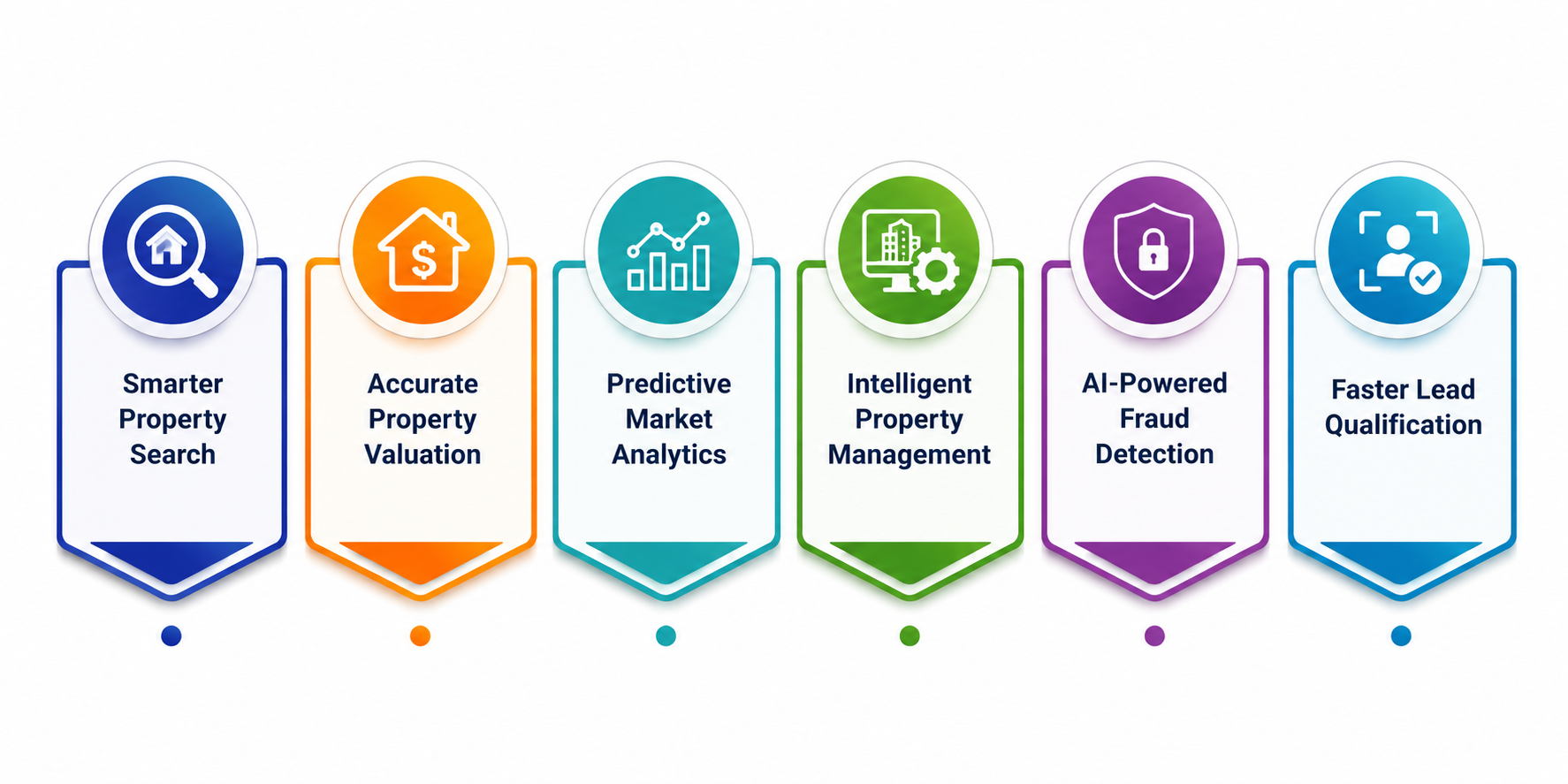
1. Smarter Property Search
AI-powered recommendation engines analyze customer preferences, search history, budget, location, property type, and behavioral patterns to provide highly relevant property suggestions. Instead of browsing hundreds of listings, buyers receive personalized recommendations that closely match their needs, increasing engagement and improving conversion rates for real estate businesses.
- Delivers highly personalized property recommendations
- Increases customer engagement and satisfaction
- Improves lead-to-sale conversion rates
- Reduces property search time significantly
2. Accurate Property Valuation
AI algorithms evaluate historical sales data, market trends, neighborhood developments, economic indicators, and property features to estimate accurate property values. These predictive models help investors, brokers, and developers make informed pricing decisions while minimizing risks associated with manual valuation methods.
- Provides data-driven property valuations
- Supports better investment decisions
- Reduces pricing errors and inconsistencies
- Identifies profitable investment opportunities
3. Predictive Market Analytics
Machine learning models continuously analyze large volumes of real estate data to predict market demand, rental yields, price appreciation, and investment hotspots. Businesses can leverage these insights to make proactive investment decisions and identify emerging opportunities before competitors.
- Forecasts future market trends
- Identifies high-growth investment areas
- Supports strategic business planning
- Minimizes investment risks
4. Intelligent Property Management
Managing multiple residential and commercial properties manually can be time-consuming. AI-powered property management software automates rent collection, maintenance scheduling, tenant communication, lease renewals, and utility monitoring, allowing property managers to focus on delivering better tenant experiences.
- Automates routine property management tasks
- Improves tenant satisfaction
- Reduces operational expenses
- Enhances maintenance efficiency
5. AI-Powered Fraud Detection
Real estate transactions involve significant financial investments, making fraud prevention essential. AI systems can identify suspicious activities, verify customer identities, detect forged documents, and monitor unusual transaction patterns in real time, helping businesses strengthen compliance and reduce financial risks.
- Detects fraudulent transactions early
- Enhances customer verification processes
- Supports regulatory compliance
- Improves transaction security
6. Faster Lead Qualification
AI automatically analyzes customer interactions, website behavior, demographics, and buying intent to identify high-quality leads. Sales teams can prioritize prospects that are more likely to convert, improving productivity while shortening the overall sales cycle.
- Identifies high-value prospects
- Improves sales team productivity
- Accelerates deal closures
- Enhances CRM efficiency
Emerging AI Trends Reshaping Dubai's Real Estate Industry
Artificial Intelligence is rapidly changing how real estate businesses operate in Dubai. From predictive analytics and generative AI to smart buildings and autonomous property management, AI is enabling organizations to deliver faster, smarter, and more personalized services. As customer expectations evolve and digital transformation accelerates, these emerging trends are shaping the future of Dubai's real estate ecosystem.
1. Generative AI for Property Listings and Marketing
Generative AI is helping real estate companies automate content creation by generating compelling property descriptions, social media posts, email campaigns, brochures, and digital advertisements. Marketing teams can produce high-quality content within minutes while maintaining consistency across multiple channels. This reduces manual effort and accelerates property promotions, enabling agencies to reach buyers more efficiently.
2. AI-Powered Predictive Property Pricing
Machine learning algorithms analyze historical transactions, neighborhood developments, economic indicators, buyer demand, and market fluctuations to forecast future property prices. Instead of relying solely on historical comparisons, developers and investors gain real-time pricing insights that support better investment decisions and maximize returns in Dubai's competitive real estate market.
3. Intelligent Virtual Assistants and AI Agents
Modern AI agents are evolving beyond traditional chatbots by understanding customer intent, answering complex questions, scheduling appointments, qualifying leads, and guiding buyers throughout the property journey. These intelligent assistants operate 24/7, improving customer engagement while allowing sales teams to focus on closing high-value deals.
4. AI-Driven Smart Buildings
Smart buildings are becoming increasingly common across Dubai. AI-powered systems automatically monitor energy consumption, HVAC performance, lighting, security, and maintenance requirements. Predictive maintenance identifies equipment failures before they occur, reducing operational costs, minimizing downtime, and enhancing the overall tenant experience.
5. AI-Powered Virtual Property Tours
Virtual tours enhanced with Artificial Intelligence provide immersive experiences that allow buyers to explore residential and commercial properties remotely. AI personalizes these tours based on customer preferences by highlighting relevant rooms, amenities, and nearby attractions, making property viewing more engaging for local and international investors.
Cost of Developing AI-Powered Real Estate Software in the Middle East
Cost to develop an AI-powered real estate software is a strategic investment that helps businesses automate operations, improve customer engagement, and make data-driven decisions. The overall development cost depends on the application's complexity, AI capabilities, third-party integrations, deployment model, and customization requirements. Whether you are building an AI-powered property portal, brokerage platform, property management system, or enterprise real estate solution, understanding the cost components helps businesses plan their budget effectively.
Development Type | Estimated Cost (USD) | Estimated Timeline | Ideal For |
Minimum Viable Product (MVP) | $20,000 – $40,000 | 3–5 Months | Startups validating an AI real estate idea |
Basic AI Real Estate Software | $40,000 – $70,000 | 4–6 Months | Small real estate agencies and brokers |
Mid-Scale AI Real Estate Platform | $70,000 – $120,000 | 6–9 Months | Growing businesses with multiple AI features |
Enterprise AI Real Estate Software | $120,000 – $250,000 | 9–15 Months | Large real estate firms, developers, and property management companies |
Advanced AI Ecosystem with Generative AI & Predictive Analytics | $250,000+
| 12–18+ Months | Enterprises requiring intelligent automation, AI agents, analytics, CRM, ERP, and cloud integrations |
Factors That Influence the Cost of Real Estate Software Development
Several technical and business factors determine the total investment required for AI-powered real estate software. Carefully evaluating these factors during the planning stage helps organizations prioritize features, optimize development costs, and achieve a higher return on investment.
1. Project Scope and Software Complexity
A simple AI-enabled property listing platform costs significantly less than a comprehensive enterprise solution with CRM, ERP integration, predictive analytics, tenant management, and investment dashboards. The number of modules, workflows, and business processes directly impacts development time, team size, and overall project cost.
2. AI Features and Intelligence Level
The sophistication of AI capabilities plays a major role in pricing. Features such as predictive property valuation, recommendation engines, generative AI, natural language processing, computer vision, fraud detection, and intelligent AI agents require advanced model development, training, and optimization, increasing both development effort and infrastructure costs.
3. UI/UX Design Requirements
A modern, intuitive, and responsive user interface enhances customer engagement and improves usability. Interactive dashboards, AI-powered search, personalized user journeys, mobile responsiveness, multilingual support, and accessibility features require additional design and front-end development resources, influencing the project's overall budget.
4. Third-Party Integrations
Real estate platforms often integrate with CRM systems, ERP software, payment gateways, GIS mapping services, property listing portals, government databases, document management systems, and communication tools. The number and complexity of these integrations can significantly affect implementation costs and development timelines.
5. Cross-Platform Compatibility
Businesses targeting both Android and iOS users may choose native or cross-platform development. Supporting multiple devices, tablets, web applications, and responsive interfaces increases testing, optimization, and maintenance efforts, resulting in higher overall development costs.
6. Cloud Infrastructure
AI applications rely on cloud infrastructure for model training, data storage, processing, and scalability. Hosting on platforms like jiWebHosting, AWS, Microsoft Azure, or Google Cloud requires ongoing investment in computing resources, GPU instances, databases, storage, and AI services, contributing to long-term operational expenses.
The Future of AI-Powered Real Estate Software in Dubai
Artificial Intelligence is set to redefine Dubai's real estate landscape by making property transactions faster, smarter, and more customer-centric. As the UAE continues to invest in AI, smart cities, and digital transformation, real estate businesses will increasingly rely on intelligent technologies to automate operations, improve decision-making, and deliver exceptional customer experiences. Companies that embrace AI today will be well-positioned to lead tomorrow's highly competitive property market.
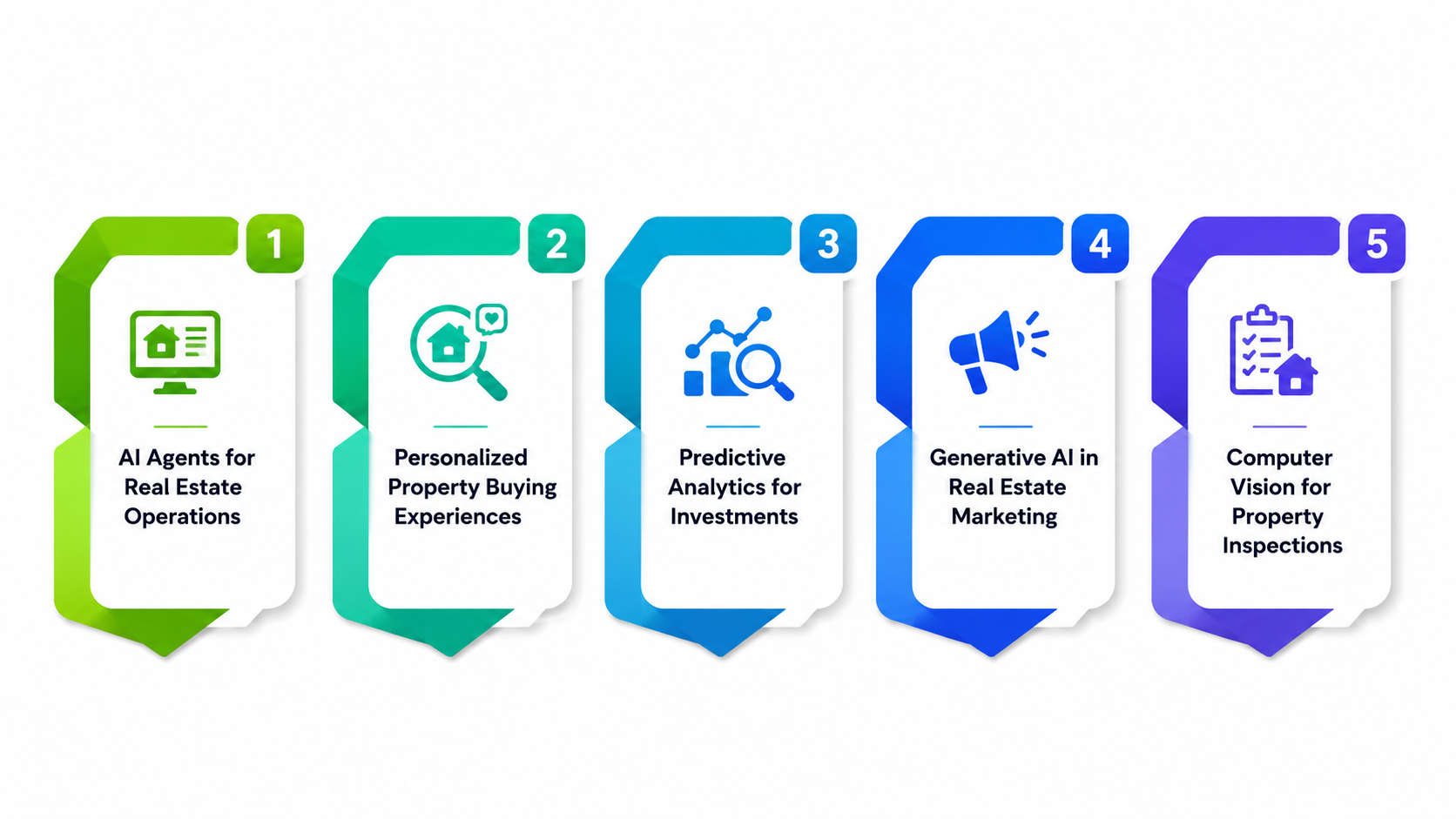
1. AI Agents for Real Estate Operations
AI agents are expected to become an integral part of real estate businesses by handling customer inquiries, qualifying leads, scheduling property visits, managing follow-ups, and assisting with documentation. These intelligent assistants will reduce manual workloads while enabling sales teams to focus on high-value interactions and closing deals.
2. Personalized Property Buying Experiences
Future AI systems will analyze customer behavior, investment goals, browsing history, and financial preferences to deliver highly personalized property recommendations. Buyers will receive tailored property suggestions, financing options, and neighborhood insights, creating a seamless and engaging property-buying journey.
3. Predictive Analytics for Investments
Advanced machine learning models will help investors forecast property demand, rental yields, infrastructure growth, and market fluctuations with greater accuracy. These insights will enable developers and investors to identify high-potential opportunities earlier, reducing investment risks and maximizing long-term returns.
4. Generative AI in Real Estate Marketing
Generative AI will continue transforming property marketing by creating high-quality listings, social media campaigns, brochures, videos, email content, and advertising materials within minutes. Real estate businesses will benefit from faster campaign execution, improved brand consistency, and enhanced customer engagement across digital channels.
5. Computer Vision for Property Inspections
AI-powered computer vision will automate property inspections by identifying structural defects, maintenance requirements, safety hazards, and construction progress through images and videos. This technology will improve inspection accuracy, reduce manual effort, and accelerate project completion for developers and property managers.
Conclusion
Dubai is rapidly emerging as a global hub for innovation, and Artificial Intelligence is playing a pivotal role in transforming its real estate industry. From predictive analytics and intelligent property recommendations to AI-powered chatbots, smart property management, and automated decision-making, AI is enabling businesses to operate more efficiently while delivering exceptional customer experiences.
As customer expectations continue to evolve and competition intensifies, investing in AI-powered real estate software is no longer just a technological upgrade,it is a strategic business decision. Organizations that embrace AI today will be better positioned to increase operational efficiency, enhance customer engagement, reduce costs, and unlock new revenue opportunities.
At ToXSL Technologies, we specialize in developing custom AI-powered real estate software tailored to your business needs. With expertise in Artificial Intelligence, Machine Learning, Generative AI, enterprise software, mobile applications, and cloud technologies, our team helps real estate agencies, property developers, and brokers build intelligent, scalable, and secure digital solutions. Whether you need an AI-powered property portal, smart property management platform, predictive analytics system, or an enterprise-grade real estate application, we deliver innovative solutions that drive measurable business growth.
Frequently Asked Questions
1. Why should real estate companies invest in AI-powered software?
AI-powered software helps automate business operations, improve customer experiences, enhance decision-making, and increase profitability through intelligent automation and predictive analytics.
Key Benefits:
- Reduces manual workload
- Improves customer engagement
- Increases sales efficiency
- Supports data-driven decisions
2. What AI features should a real estate platform include?
Modern real estate software should include AI chatbots, predictive property valuation, recommendation engines, virtual property tours, lead scoring, fraud detection, and intelligent analytics dashboards.
Essential Features:
- AI-powered search
- Predictive analytics
- Virtual assistants
- Smart reporting dashboards
3. How much does AI-powered real estate software cost in the Middle East?
The cost depends on project scope, AI capabilities, integrations, platform complexity, and customization. Basic solutions start around USD 20,000, while enterprise-grade platforms can exceed USD 250,000.
Cost Factors:
- AI functionality
- Software complexity
- Third-party integrations
- Cloud infrastructure
4. How long does it take to develop AI real estate software?
Development timelines vary based on features and complexity. A Minimum Viable Product (MVP) typically takes 3–5 months, while enterprise AI platforms may require 9–15 months or more.
Timeline Depends On:
- Project requirements
- AI model development
- Design complexity
- Testing and deployment
5. Can AI improve property management operations?
Yes. AI automates maintenance scheduling, tenant communication, rent collection, energy monitoring, and predictive maintenance, improving operational efficiency and reducing management costs.
Advantages:
- Automated maintenance
- Faster tenant support
- Lower operational costs
- Better resource utilization
6. Is AI-powered real estate software secure?
Yes. When developed with modern security practices, AI-powered software includes encryption, role-based access control, identity verification, secure APIs, and compliance with applicable data protection regulations.
Security Features:
- Data encryption
- User authentication
- Fraud detection
- Access management
7. Why choose ToXSL Technologies for AI real estate software development?
ToXSL Technologies offers end-to-end AI development services with expertise in custom software, Generative AI, Machine Learning, mobile applications, and enterprise solutions tailored for the real estate industry.
Why Partner with ToXSL Technologies?
- AI development expertise
- Customized business solutions
- Scalable and secure architecture
- End-to-end development and support