- Jul 29, 2026
Share this post on:
Key Takeaways
- Custom CRM software helps businesses automate sales, marketing, customer support, and business operations from a single platform.
- Dubai businesses benefit from CRM solutions tailored to local regulations, multilingual customers, and rapidly growing digital markets.
- Custom CRM systems improve customer retention, employee productivity, and decision-making through centralized data management.
- The cost of custom CRM development depends on project complexity, integrations, features, technologies, and development timelines.
- AI-powered CRM features such as predictive analytics, chatbots, workflow automation, and personalized customer engagement are becoming business essentials.
- Choosing an experienced CRM development company ensures scalable architecture, secure integrations, and long-term business growth.
Customer relationships are the foundation of every successful business. Whether you operate in retail, healthcare, real estate, finance, logistics, hospitality, or eCommerce, managing customer interactions effectively has become essential for sustainable growth. As Dubai continues its journey toward becoming one of the world's leading digital economies, businesses are increasingly investing in intelligent technologies that improve customer experiences and streamline internal operations.
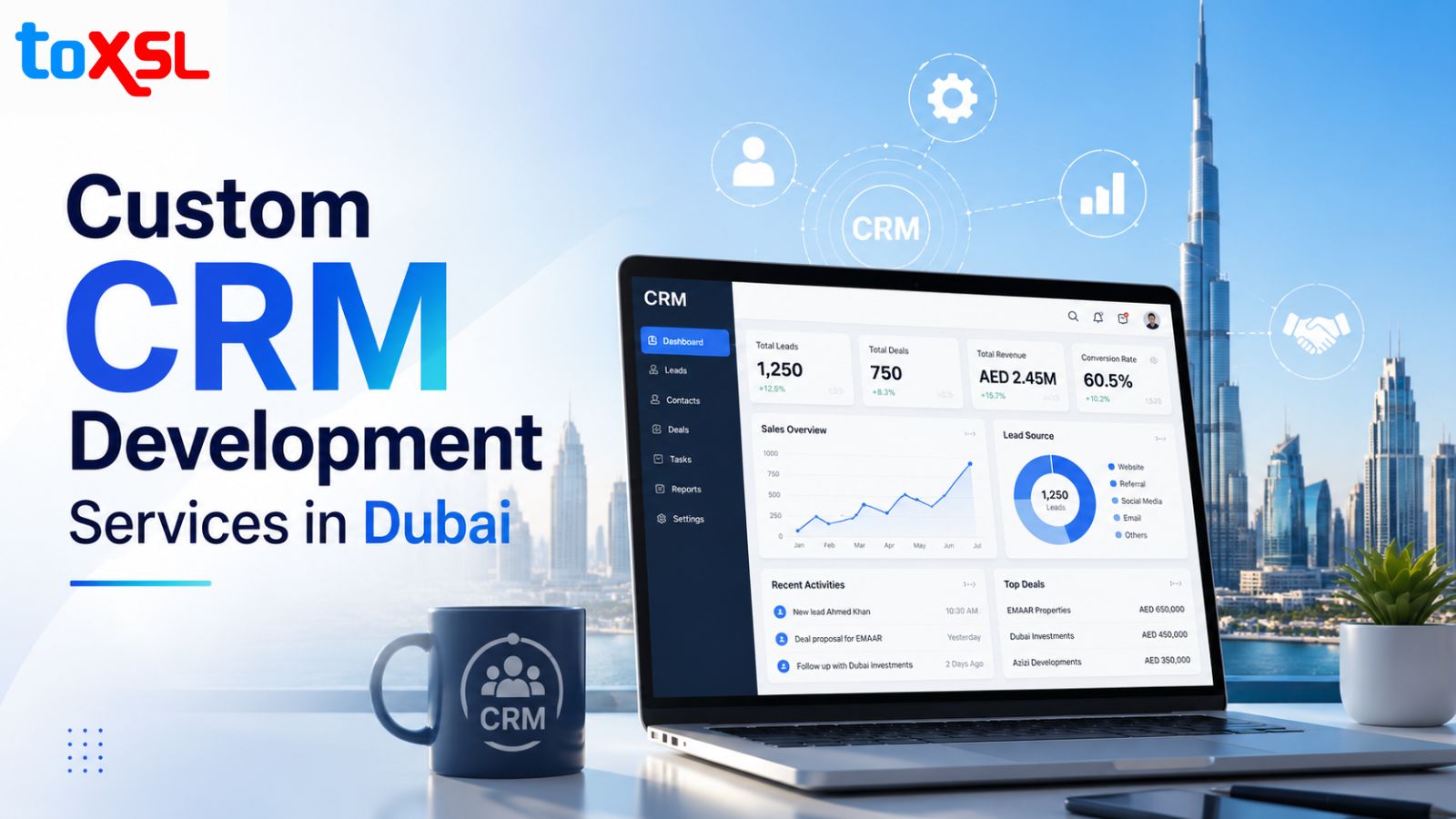
A Customer Relationship Management (CRM) system enables organizations to manage customer information, monitor sales pipelines, automate workflows, improve marketing campaigns, and deliver personalized customer service. While many businesses begin with ready-made CRM platforms, these solutions often fail to meet industry-specific requirements or accommodate unique business workflows.
This is where custom CRM development services provide significant value. A tailor-made CRM is designed around your organization's exact business processes rather than forcing your business to adapt to generic software limitations. From integrating ERP systems and accounting software to enabling AI-driven analytics, automation, and real-time reporting, custom CRM solutions provide unmatched flexibility and scalability.
According to Grand View Research, the global Customer Relationship Management (CRM) market is projected to surpass USD 161 billion by 2033, driven by increasing cloud adoption, AI integration, and the growing demand for customer-centric business solutions across industries. Dubai's competitive business environment demands technology that supports rapid expansion, regulatory compliance, multilingual customer engagement, and seamless digital transformation. Organizations across the UAE are increasingly adopting customized CRM platforms to improve operational efficiency, enhance customer satisfaction, and gain a competitive advantage.
How Custom CRM Development Gives Dubai Businesses a Competitive Edge
Custom CRM development empowers Dubai businesses to streamline operations, strengthen customer relationships, and respond quickly to changing market demands. Unlike off-the-shelf software, a tailored CRM aligns with unique business workflows, enabling organizations to improve efficiency, enhance collaboration, and make data-driven decisions that support sustainable growth and long-term competitive advantage.
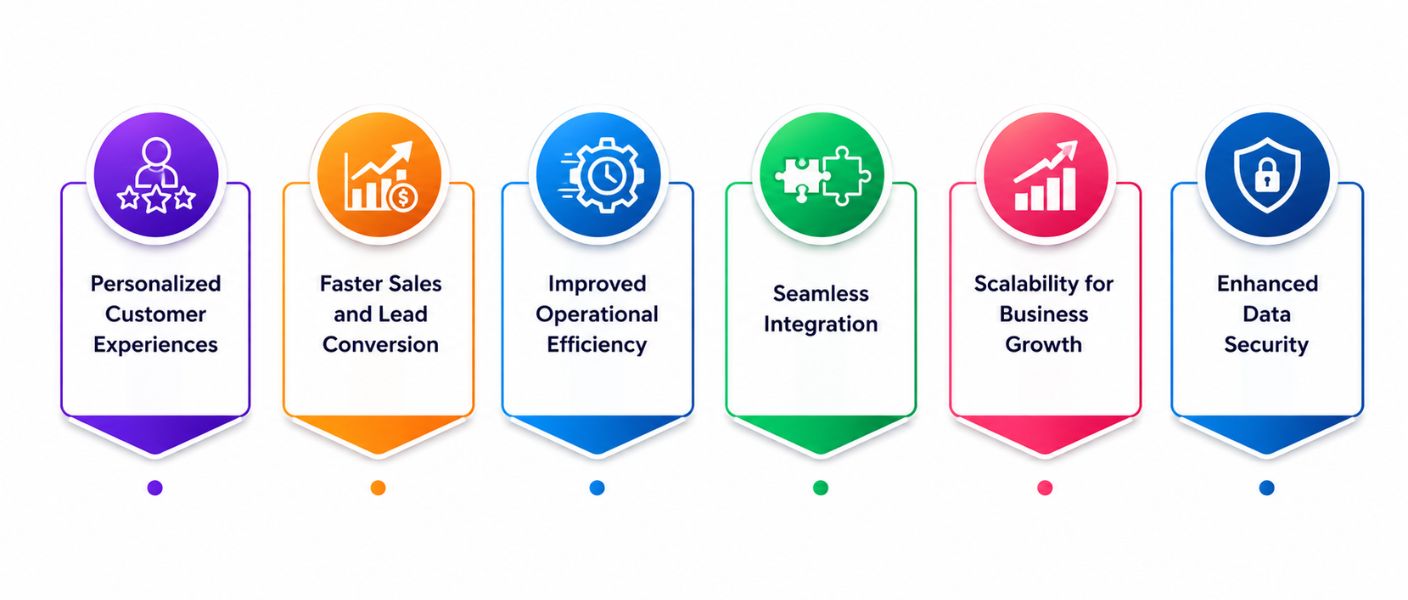
1. Personalized Customer Experiences
A custom CRM centralizes customer information, purchase history, communication records, and preferences, allowing businesses to deliver highly personalized interactions. This helps sales and support teams understand customer needs better, resulting in stronger relationships, higher satisfaction, and improved customer retention across every stage of the customer journey.
2. Faster Sales and Lead Conversion
Custom CRM systems automate lead management, follow-up reminders, quotation generation, and sales pipeline tracking. Sales teams gain complete visibility into every opportunity, enabling them to prioritize high-value prospects, reduce response times, and convert more leads into loyal customers with greater efficiency.
3. Improved Operational Efficiency
By automating repetitive tasks such as data entry, approvals, reporting, and customer follow-ups, a custom CRM minimizes manual effort and reduces operational errors. Employees spend more time focusing on strategic activities, improving productivity while ensuring business processes remain consistent and efficient across departments.
4. Seamless Integration
A custom CRM integrates effortlessly with ERP software in Dubai, accounting platforms, payment gateways, marketing automation tools, HR systems, and communication applications. These integrations create a unified business ecosystem, eliminate data silos, improve collaboration, and ensure accurate information is available across every department.
5. Scalability for Business Growth
As businesses expand, their operational requirements evolve. A custom CRM software is designed with scalable architecture, allowing organizations to add new users, features, modules, and integrations without disrupting existing workflows. This flexibility ensures the CRM continues supporting future growth and changing business needs.
6. Enhanced Data Security
Custom CRM solutions incorporate advanced security measures such as data encryption, role-based access control, multi-factor authentication, and automated backups. These features protect sensitive customer information, reduce cybersecurity risks, and help businesses comply with industry regulations while maintaining customer trust.
Key Features of a Custom CRM System
A modern custom CRM system is much more than a customer database - it serves as the central hub for managing sales, marketing, customer support, operations, and business intelligence. By combining automation, real-time data, and seamless integrations, a custom CRM helps organizations improve customer relationships, streamline workflows, and make data-driven decisions. Below are some of the essential features every custom CRM should include.
1. Customer Database Management
A custom CRM provides a centralized repository where businesses can securely store and organize complete customer information. From contact details and communication history to purchase records, invoices, contracts, support tickets, and previous interactions, everything is available in one place. This enables teams to quickly access accurate customer data, deliver personalized experiences, and eliminate the inefficiencies caused by scattered spreadsheets or disconnected systems.
2. Sales Pipeline Management
An effective CRM enables businesses to manage the complete sales lifecycle, from capturing new leads to closing deals and maintaining long-term customer relationships. Sales teams can visualize every stage of the pipeline, assign leads to representatives, set reminders, monitor follow-ups, forecast revenue, and identify bottlenecks that may delay conversions. This improves team productivity while ensuring no sales opportunity is overlooked.
3. Marketing Automation
Custom CRM software simplifies marketing activities by automating repetitive campaigns and customer engagement processes. Businesses can segment audiences based on demographics, behavior, or purchase history, schedule personalized email campaigns, create automated customer journeys, and nurture leads until they are ready to convert. Marketing performance can also be measured through real-time analytics, enabling continuous optimization of campaigns.
4. Workflow Automation
Workflow automation helps businesses reduce manual effort by automating repetitive operational tasks across departments. A custom CRM can automatically assign leads, send follow-up emails, generate invoices, schedule meetings, trigger approval requests, create reminders, and notify employees of important updates. Automation minimizes human errors, improves operational efficiency, and allows employees to focus on high-value business activities.
5. Customer Support Management
Providing excellent customer service becomes easier with an integrated support management system. A custom CRM enables businesses to manage customer inquiries, complaints, service requests, live chat conversations, and support tickets from a single dashboard. Support teams can track issue status, assign tickets to agents, monitor response times, and maintain complete customer interaction histories to deliver faster and more personalized support.
6. AI-Powered Analytics
Artificial intelligence enhances CRM capabilities by transforming customer data into valuable business insights. AI-powered analytics can identify purchasing patterns, predict customer behavior, recommend cross-selling and upselling opportunities, forecast sales performance, detect churn risks, and generate detailed reports. These insights help businesses make informed strategic decisions while improving customer engagement and increasing revenue.
Business Advantages of Custom CRM Development Services in Dubai
Custom CRM software provides far more than customer management—it becomes the digital backbone of an organization by connecting departments, improving collaboration, and enabling data-driven decision-making. Unlike off-the-shelf solutions, customized CRM platforms align perfectly with business objectives, making them an ideal investment for companies seeking long-term growth, operational efficiency, and exceptional customer experiences in Dubai's competitive marketplace.
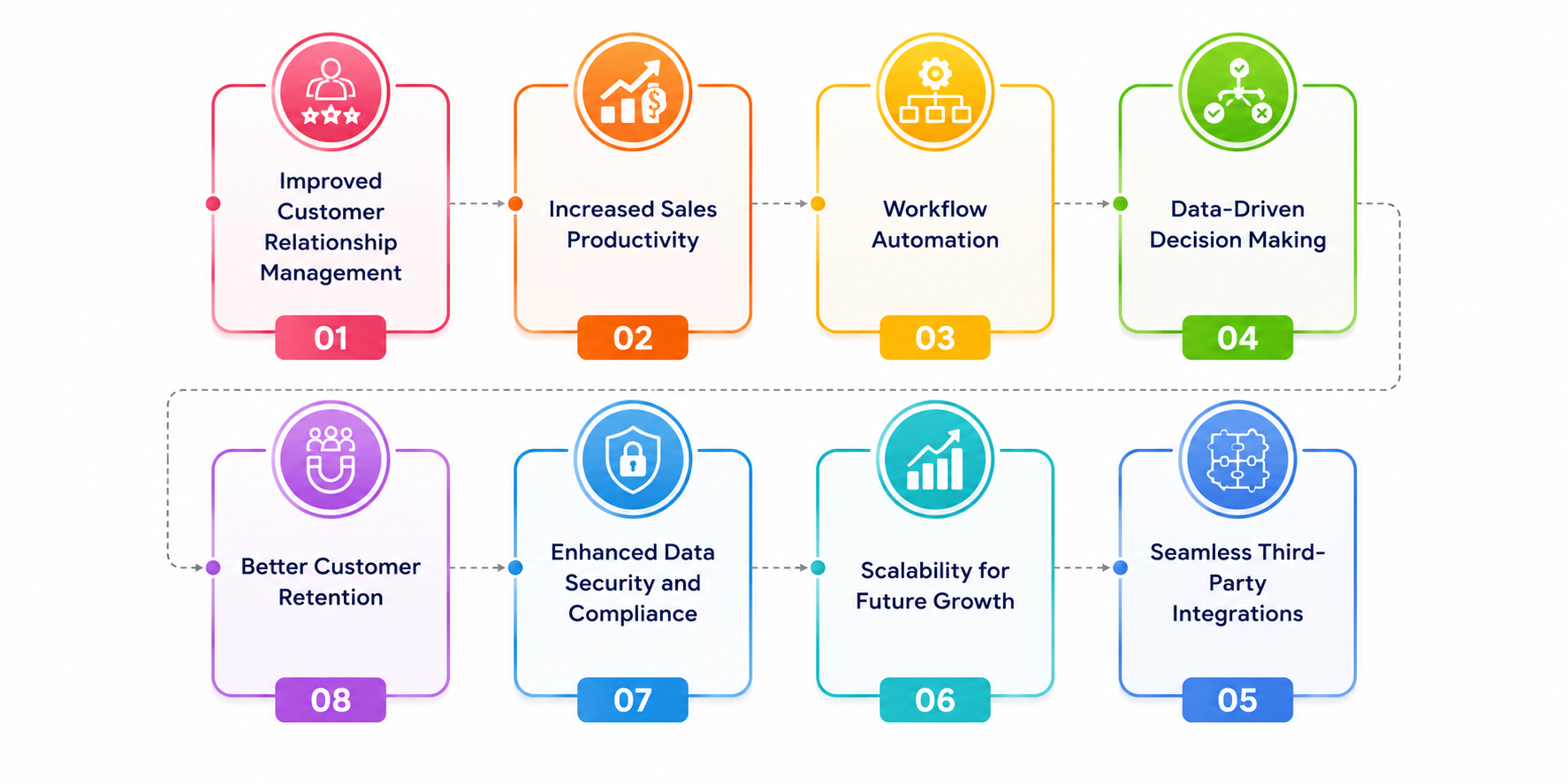
1. Improved Customer Relationship Management
A custom CRM provides businesses with a complete 360-degree view of every customer. Sales representatives, support teams, and marketing professionals can instantly access customer histories, communication records, preferences, and purchase behavior. This centralized information enables personalized interactions, quicker issue resolution, and stronger long-term customer relationships.
Benefits:
- Personalized customer experiences
- Faster customer support
- Improved communication across departments
- Higher customer satisfaction and loyalty
2. Increased Sales Productivity
Sales teams spend less time on administrative tasks and more time engaging with prospects. Automated lead tracking, follow-up reminders, quotation generation, and opportunity management help sales professionals close deals more efficiently while improving overall conversion rates and forecasting accuracy.
Benefits:
- Automated lead management
- Improved conversion rates
- Better revenue forecasting
- Faster deal closures
3. Workflow Automation
Custom CRM systems eliminate repetitive manual work by automating approvals, customer notifications, task assignments, reporting, and business processes. Automation reduces human errors, increases operational efficiency, and allows employees to focus on strategic business activities instead of routine administrative tasks.
Benefits:
- Reduced manual workload
- Faster business processes
- Fewer operational errors
- Improved employee productivity
4. Data-Driven Decision Making
Advanced dashboards and real-time analytics empower business leaders with actionable insights into sales performance, customer behavior, employee productivity, and revenue trends. Decision makers can identify growth opportunities, monitor KPIs, and optimize business strategies using accurate, real-time data.
Benefits:
- Real-time reporting
- Better forecasting accuracy
- Smarter business planning
- Performance monitoring
5. Seamless Third-Party Integrations
Businesses often rely on multiple software solutions to manage finance, HR, inventory, communication, and operations. A custom CRM integrates seamlessly with existing platforms such as ERP systems, accounting software, payment gateways, email marketing tools, cloud services, and communication platforms. This eliminates data silos, improves workflow efficiency, and ensures consistent information across departments.
Benefits:
- Unified business ecosystem
- Reduced duplicate data entry
- Faster information sharing
- Improved operational efficiency
6. Scalability for Future Growth
As businesses expand, their operational requirements evolve. A custom CRM is built with scalability in mind, allowing organizations to add new users, modules, integrations, automation rules, and business processes without rebuilding the system. This flexibility ensures the CRM continues supporting business growth for years.
Benefits:
- Supports business expansion
- Easy feature enhancements
- Flexible system architecture
- Long-term technology investment
7. Enhanced Data Security and Compliance
Dubai businesses handle sensitive customer information that requires robust security measures. Custom CRM solutions incorporate advanced encryption, role-based access controls, secure authentication, automated backups, and compliance with regional data protection regulations. These security measures protect valuable business data while building customer trust.
Benefits:
- Secure customer information
- Compliance with regulations
- Controlled user access
- Reduced cybersecurity risks
8. Better Customer Retention
Acquiring a customer is only the beginning. Retaining customers requires personalized communication, timely support, and continuous engagement. A custom CRM enables businesses to automate follow-ups, schedule reminders, track customer preferences, and deliver targeted marketing campaigns, resulting in stronger customer relationships and increased lifetime value.
Benefits:
- Higher customer loyalty
- Personalized engagement
- Automated follow-ups
- Increased repeat business
Understanding the Cost of Custom CRM Development in Dubai
Developing a custom CRM is a strategic investment that delivers long-term business value through improved efficiency, automation, and customer engagement. Unlike subscription-based CRM platforms, custom solutions are designed specifically for your business processes, allowing greater flexibility, scalability, and ownership.
The overall custom CRM development cost in Dubai varies depending on project complexity, required features, integrations, security requirements, deployment model, and development team expertise. Understanding these cost components helps businesses plan budgets more effectively while maximizing return on investment.
1. Basic CRM Solution
A basic CRM includes essential features such as customer management, contact storage, lead tracking, task management, dashboards, and user authentication. It is suitable for startups and small businesses seeking a centralized platform for managing customer interactions without extensive automation or integrations.
2. Mid-Level CRM Solution
A mid-level CRM includes workflow automation, sales pipeline management, customer support, analytics, role-based access, mobile responsiveness, and integration with third-party applications. It serves growing businesses that require streamlined operations and enhanced collaboration across departments.
3. Enterprise CRM Solution
Enterprise CRM systems support complex organizational structures, multiple departments, advanced analytics, AI capabilities, extensive automation, cloud infrastructure, multilingual functionality, and enterprise-grade security. These systems are designed for large organizations managing thousands of customers and high transaction volumes.
Estimated CRM Development Cost
CRM Type | Estimated Cost (USD) | Development Timeline |
Basic CRM | $15,000–$30,000 | 2–4 Months |
Mid-Level CRM | $30,000–$70,000 | 4–7 Months |
Enterprise CRM | $70,000–$180,000+ | 7–12+ Months |
Note: These estimates vary based on business requirements, integrations, technology stack, UI/UX complexity, AI features, testing, and post-launch support.
Why Dubai Businesses Prefer Custom CRM Over Ready-Made Solutions
Off-the-shelf CRM software is designed for a broad audience, often forcing businesses to adapt their workflows to fit the software. In contrast, custom CRM solutions are built around specific business processes, ensuring higher efficiency, seamless integrations, and greater flexibility.
Custom CRM | Ready-Made CRM |
Tailored to business needs | Generic features |
Fully scalable | Limited customization |
Complete ownership | Subscription-based licensing |
Seamless integrations | Integration limitations |
Higher long-term ROI | Ongoing subscription costs |
Better security control | Shared infrastructure |
Factors That Influence the Cost of Custom CRM Development
Developing a custom CRM solution requires careful planning and budgeting. The final development cost depends on several technical and business factors, including project scope, required features, integrations, security requirements, technology stack, and deployment model. Understanding these factors helps businesses make informed investment decisions while ensuring the CRM delivers maximum value and long-term scalability.
1. Feature Complexity
The number and complexity of features significantly impact CRM development costs. A basic CRM with contact management and lead tracking requires less development time than an enterprise-grade solution with AI, workflow automation, predictive analytics, and advanced reporting. Businesses should prioritize features that align with their goals while planning for future scalability.
Key Considerations:
- Number of user modules
- Workflow automation requirements
- AI and analytics capabilities
- Reporting and dashboard complexity
2. Third-Party Integrations
Most businesses use multiple software solutions, including ERP systems, accounting software, payment gateways, HR platforms, email marketing tools, and communication applications. Integrating these systems with the CRM requires additional development effort, testing, and API management, increasing the overall project cost while improving operational efficiency.
Key Considerations:
- ERP integration
- Payment gateway connectivity
- Marketing automation tools
- Cloud service integrations
3. UI/UX Design
A user-friendly interface plays a crucial role in CRM adoption. Custom dashboards, intuitive navigation, responsive layouts, and personalized user experiences require dedicated UI/UX design efforts. Investing in high-quality design improves employee productivity, reduces training time, and enhances overall software usability.
Key Considerations:
- Responsive design
- Custom dashboards
- User journey optimization
- Interactive interfaces
4. Technology Stack
The choice of programming languages, frameworks, databases, cloud infrastructure, and development tools directly affects project costs. Modern technologies provide better performance, security, and scalability but may require experienced developers. Selecting the right technology stack ensures long-term maintainability and future business growth.
Key Considerations:
- Front-end framework
- Back-end technology
- Database selection
- Cloud infrastructure
5. Security Requirements
Businesses handling sensitive customer information require enterprise-grade security. Features such as multi-factor authentication, role-based access control, data encryption, audit logs, secure APIs, and automated backups increase development complexity while ensuring compliance and protecting critical business data.
Key Considerations:
- Data encryption
- User authentication
- Role-based permissions
- Regulatory compliance
6. Mobile Accessibility
Many organizations require employees to access CRM systems remotely using smartphones and tablets. Developing responsive web applications or dedicated mobile apps in Dubai requires additional resources but enables field sales teams, managers, and customer support representatives to work efficiently from anywhere.
Key Considerations:
- Android compatibility
- iOS compatibility
- Offline access
- Real-time synchronization
Best Practices for Successful Custom CRM Development
A successful CRM project goes beyond software development. It requires strategic planning, user-centric design, scalable architecture, and continuous optimization. Following industry best practices ensures the CRM aligns with business goals, delivers measurable results, and adapts to changing customer and market demands.
1. Clearly Define Business Objectives
Every CRM project should begin with well-defined business goals. Organizations should identify pain points, customer management challenges, workflow inefficiencies, and desired outcomes before development begins. Clear objectives help developers build features that solve real business problems and maximize return on investment.
Best Practices:
- Define measurable KPIs
- Identify business challenges
- Prioritize essential features
- Create a development roadmap
2. Focus on User Experience
A CRM is only effective if employees actively use it. Designing an intuitive, easy-to-navigate interface reduces training time, improves adoption, and increases productivity. User feedback during development helps create a solution that aligns with daily business operations.
Best Practices:
- Simple navigation
- Responsive interface
- Personalized dashboards
- Regular usability testing
3. Build a Scalable Architecture
Business requirements evolve over time, making scalability a critical factor in CRM development. A modular architecture allows organizations to add new features, users, and integrations without disrupting existing operations or requiring major redevelopment.
Best Practices:
- Modular architecture
- Cloud-ready infrastructure
- API-first development
- Flexible database design
4. Prioritize Security from Day One
Security should never be treated as an afterthought. Incorporating encryption, secure authentication, access controls, regular vulnerability assessments, and compliance measures during development protects customer information and reduces cybersecurity risks.
Best Practices:
- Encrypt sensitive data
- Enable multi-factor authentication
- Conduct security audits
- Maintain regular backups
5. Integrate Existing Business Systems
A CRM should work seamlessly with existing business applications rather than operate independently. Integrating ERP, accounting, HR, inventory, email, and communication systems creates a unified business ecosystem that improves efficiency and eliminates duplicate data entry.
Best Practices:
- API-based integrations
- Real-time synchronization
- Automated data exchange
- Centralized reporting
6. Test Before Deployment
Comprehensive testing ensures the CRM performs reliably under different conditions. Functional testing, security testing, performance testing, and user acceptance testing help identify issues before deployment, minimizing downtime and improving user satisfaction.
Best Practices:
- Functional testing
- Security testing
- Performance optimization
- User acceptance testing
7. Continuously Improve the CRM
CRM development does not end after deployment. Businesses should regularly monitor system performance, gather user feedback, implement updates, and introduce new features to keep the platform aligned with evolving customer expectations and business requirements.
Best Practices:
- Collect user feedback
- Monitor KPIs
- Release regular updates
- Add new features strategically
Conclusion
For businesses in Dubai, investing in a customized CRM platform provides a strategic advantage by enabling greater flexibility, seamless integrations, stronger security, and long-term scalability. As technology continues to evolve with artificial intelligence, automation, and advanced analytics, custom CRM solutions will remain a key driver of business transformation.
At ToXSL Technologies, we specialize in delivering innovative, scalable, and secure custom CRM development services tailored to your business objectives. From consultation and UI/UX design to development, integration, deployment, and ongoing support, our team is committed to helping businesses build intelligent CRM solutions that improve efficiency, strengthen customer relationships, and drive sustainable growth.
Frequently Asked Questions
1. What is custom CRM development?
Custom CRM development is the process of designing and building a customer relationship management system tailored to a company's specific workflows, business goals, and operational requirements. Unlike off-the-shelf software, a custom CRM offers personalized features, seamless integrations, and greater flexibility.
2. Why should businesses in Dubai choose a custom CRM?
Dubai businesses operate in diverse and competitive industries with unique customer engagement requirements. A custom CRM provides industry-specific functionality, multilingual support, advanced automation, enhanced security, and seamless integration with existing business systems, enabling organizations to improve efficiency and customer satisfaction.
3. How long does it take to build a custom CRM?
Development timelines depend on the project's scope and complexity. A basic CRM may take 2–4 months, a mid-level solution 4–7 months, and a comprehensive enterprise CRM with advanced integrations and AI capabilities 7–12 months or longer.
4. Which industries benefit the most from custom CRM solutions?
Custom CRM systems are valuable across numerous industries, including real estate, healthcare, banking, insurance, retail, eCommerce, logistics, manufacturing, hospitality, education, travel, construction, and professional services. Any organization managing customer relationships can benefit from a tailored CRM platform.
5. Why choose ToXSL Technologies for custom CRM development?
ToXSL Technologies offers end-to-end custom CRM development services in Dubai, including business analysis, UI/UX design, software development, third-party integrations, cloud deployment, AI-powered automation, testing, maintenance, and ongoing support. Our experienced team delivers scalable, secure, and future-ready CRM solutions that help businesses improve customer relationships and achieve sustainable growth.