- Jun 02, 2026
- Real Estate
- 379
Share this post on:
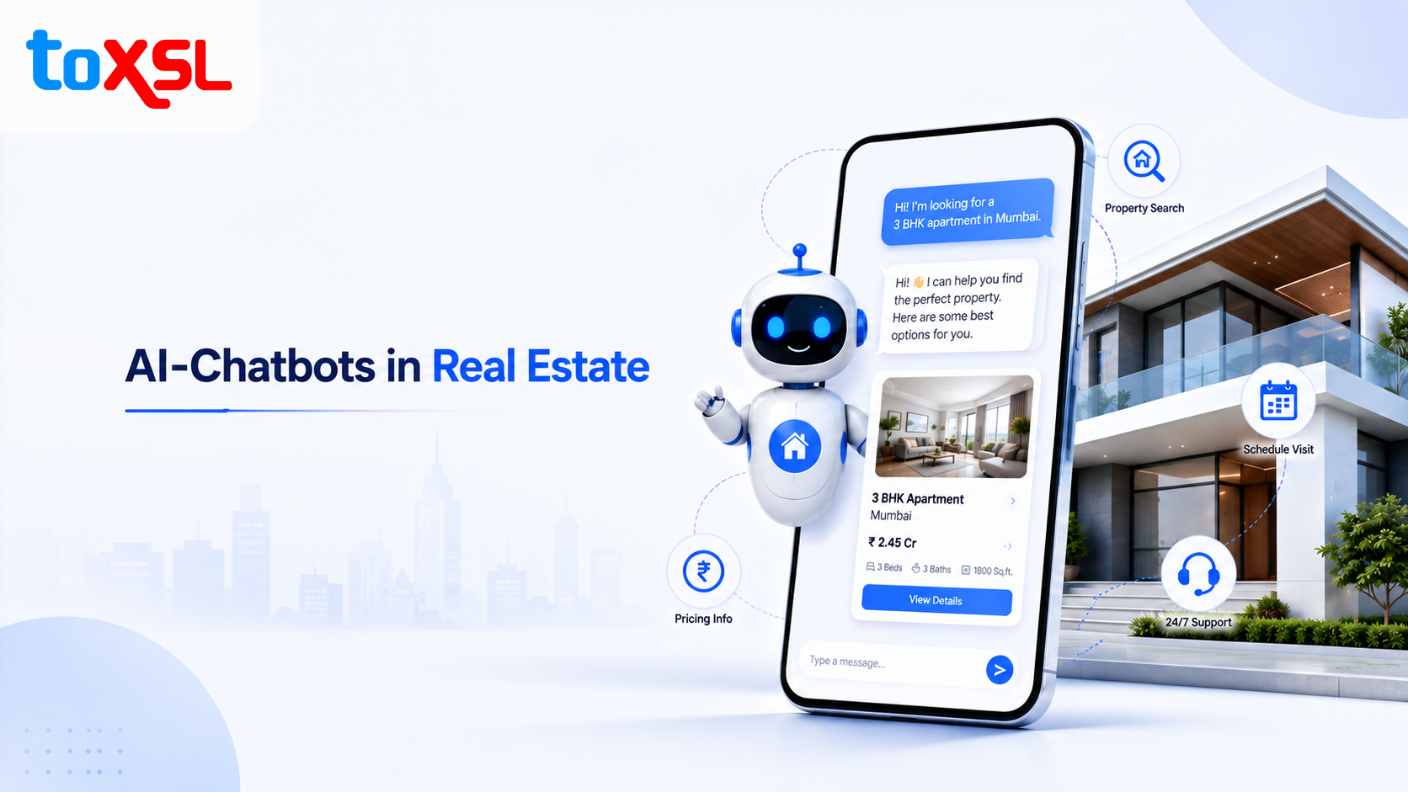
The global chatbot market size is projected to reach USD 41,244.2 million by 2033, growing at a CAGR of 19.6% from 2026 to 2033. The market is witnessing rapid expansion due to continuous advancements in artificial intelligence (AI), machine learning, and natural language processing technologies. Businesses across multiple industries are increasingly adopting AI-powered chatbots to improve customer experiences, automate communication processes, and enhance operational efficiency.
The real estate industry is rapidly evolving with the integration of artificial intelligence (AI) technologies. Among the most transformative innovations are AI-powered chatbots, which are changing how real estate companies interact with buyers, sellers, investors, and tenants. From answering property inquiries instantly to scheduling site visits and providing personalized recommendations, AI chatbots are streamlining operations and improving customer experiences across the industry.
AI chatbots are not limited to answering basic questions. Advanced chatbots now use natural language processing (NLP), machine learning, and predictive analytics to understand customer behavior, recommend properties, qualify leads, and even support virtual property tours. These intelligent systems are becoming essential tools for real estate agencies, brokers, property management companies, and developers looking to stay competitive.
Key Takeaways
AI chatbots provide 24/7 customer support and improve response times in real estate businesses.
Real estate chatbots help automate lead generation, appointment scheduling, and property recommendations.
AI-powered virtual assistance improves customer engagement and increases conversion rates.
Advanced chatbot technologies such as NLP and machine learning are transforming property search experiences.
AI chatbots are becoming a major trend in the real estate industry, helping businesses reduce costs and improve operational efficiency.
Understanding AI-Chatbots in Real Estate
AI chatbots in real estate are intelligent virtual assistants designed to communicate with users through websites, mobile applications, and messaging platforms. These chatbots use artificial intelligence technologies such as machine learning and natural language processing to understand customer queries and provide accurate responses in real time.
In the real estate sector, chatbots help buyers search for properties, answer pricing questions, provide neighborhood details, schedule appointments, and assist with property comparisons. They can also collect customer preferences and recommend suitable properties based on budget, location, and lifestyle requirements.
Unlike traditional customer support systems, AI chatbots can handle multiple conversations simultaneously without delays. This allows real estate businesses to improve customer engagement while reducing operational workloads. Chatbots can also integrate with web apps, CRM systems, property databases, and marketing platforms to create seamless communication experiences.
As digital property searches continue to grow, AI chatbots in mobile app development are becoming valuable tools for improving lead generation, customer retention, and overall business efficiency.
Smart Features Powering Customer Engagement and Business Growth
AI-powered real estate chatbots offer a wide range of advanced features that improve customer experiences and support business growth. These smart capabilities help companies automate communication, provide instant assistance, and increase lead conversion rates.
1. 24/7 Customer Support
AI chatbots provide round-the-clock support to potential buyers and tenants without requiring human intervention. Customers can receive immediate responses to inquiries about properties, pricing, availability, and documentation at any time, improving satisfaction and increasing engagement opportunities for real estate businesses.
Provides instant responses to customer inquiries
Reduces waiting time for property-related questions
Increases customer satisfaction and engagement
Ensures business availability beyond office hours
2. Intelligent Property Recommendations
AI chatbots analyze customer preferences such as location, budget, property type, and amenities to recommend suitable properties. This personalized approach improves the customer experience and helps users find relevant listings faster, increasing the chances of successful property sales and lead conversions.
Offers personalized property suggestions
Matches listings based on customer preferences
Improves property discovery experiences
Enhances lead conversion opportunities
3. Automated Lead Qualification
Real estate ai chatbots automatically collect customer information and identify high-quality leads based on user behavior and preferences. This feature allows sales teams to focus on serious buyers while reducing time spent on unqualified inquiries and improving overall sales productivity.
Collects customer data automatically
Identifies potential high-value buyers
Reduces manual lead filtering efforts
Improves sales team productivity
4. Appointment Scheduling and Follow-Ups
AI chatbots simplify appointment booking by allowing customers to schedule property visits directly through chat interfaces. They also send automated reminders and follow-up messages, reducing missed appointments and helping agents maintain better communication with clients throughout the sales process.
Enables easy property visit scheduling
Sends automated reminders to clients
Reduces missed appointments significantly
Improves communication with prospects
5. Multilingual Communication
Modern AI chatbots support multiple languages, enabling real estate companies to interact with diverse audiences globally. This feature improves accessibility, enhances customer engagement, and helps businesses attract international buyers and investors without language barriers affecting communication quality.
Supports communication in multiple languages
Improves customer accessibility worldwide
Helps attract global property investors
Eliminates language-related communication barriers
6. Integration with CRM Systems
AI chatbots integrate with customer relationship management systems to store customer data, track interactions, and manage leads efficiently. This integration ensures seamless communication between marketing and sales teams while improving customer relationship management and business decision-making.
Centralizes customer interaction data
Improves lead tracking and management
Enhances coordination between teams
Supports data-driven business decisions
7. Virtual Property Assistance
Chatbots can guide users through virtual tours, provide property details, and answer questions during online property exploration. This feature improves digital property viewing experiences and allows customers to gather information conveniently before making purchasing decisions.
Assists users during virtual property tours
Provides real-time property information
Improves online viewing experiences
Helps customers make informed decisions
8. Instant Query Resolution
AI chatbots instantly respond to frequently asked questions related to property availability, loan options, legal documentation, and payment plans. Quick query resolution improves customer trust and reduces response delays that could otherwise lead to lost business opportunities.
Resolves customer queries instantly
Improves customer trust and satisfaction
Reduces delays in communication
Prevents loss of potential business opportunities
Business Benefits of AI Chatbots in Real Estate
AI chatbots provide significant advantages for real estate businesses by improving efficiency, reducing operational costs, and enhancing customer interactions. These intelligent solutions help organizations remain competitive in an increasingly digital marketplace.
1. Improved Customer Experience
AI chatbots deliver faster responses and personalized assistance, improving the overall customer experience. Buyers and tenants receive instant support throughout their property search journey, which increases satisfaction levels and strengthens trust in the real estate brand.
2. Higher Lead Conversion Rates
Chatbots engage website visitors immediately and guide them through property inquiries efficiently. By providing instant information and personalized recommendations, businesses can convert more visitors into qualified leads and improve overall sales performance.
3. Reduced Operational Costs
Automating repetitive tasks such as answering common questions and scheduling appointments reduces the need for large customer support teams. Real estate Android app development companies can lower operational expenses while maintaining efficient customer service operations through AI chatbot implementation.
4. Faster Response Time
Delayed responses often result in lost opportunities in the competitive real estate market. AI chatbots respond instantly to inquiries, ensuring potential buyers remain engaged and increasing the likelihood of successful conversions and property transactions.
5. Better Lead Management
AI chatbots collect and organize customer information automatically, helping businesses manage leads more effectively. Sales teams can access valuable customer insights, prioritize serious buyers, and improve communication strategies for better business outcomes.
6. Enhanced Marketing Performance
Chatbots support marketing campaigns by engaging users, collecting customer preferences, and promoting relevant property listings. This personalized interaction improves campaign effectiveness and helps businesses generate higher-quality leads through digital marketing channels.
7. Scalability for Growing Businesses
As real estate businesses expand, handling increasing customer inquiries becomes challenging. AI chatbots can manage thousands of conversations simultaneously, making them highly scalable solutions for growing companies seeking consistent customer support.
8. Increased Agent Productivity
By automating administrative and repetitive communication tasks, chatbots allow real estate agents to focus on negotiations, relationship building, and closing deals. This improves workforce productivity and contributes to higher revenue generation.
Cost of Implementing AI Chatbots in Real Estate
The cost of developing and implementing AI chatbots in the real estate industry depends on several factors, including chatbot complexity, AI capabilities, platform integrations, customization requirements, and ongoing maintenance. Businesses can choose from basic chatbot solutions for simple customer support or advanced AI-powered systems with machine learning, predictive analytics, and CRM integration.
Small real estate agencies may prefer affordable chatbot solutions with limited features, while larger enterprises often invest in highly customized AI systems that support multilingual communication, virtual property assistance, and advanced lead management. Understanding the cost structure helps businesses plan their digital transformation strategies effectively and choose solutions that align with their operational goals and budgets.
Chatbot Type | Features Included | Estimated Cost (USD) |
Basic Real Estate Chatbot | FAQ support, lead collection, simple property inquiries | $3,000 – $8,000 |
Standard AI Chatbot | CRM integration, appointment scheduling, multilingual support | $8,000 – $20,000 |
Advanced AI Chatbot | AI recommendations, predictive analytics, advanced automation | $20,000 – $50,000 |
Enterprise-Level AI Chatbot | Custom AI models, VR integration, omnichannel communication | $50,000 – $100,000+ |
Factors Affecting AI Chatbot Development Cost
Several factors influence the overall cost of developing an AI chatbot for the real estate industry. The pricing can vary depending on the chatbot’s complexity, integration requirements, customization level, and maintenance needs. Businesses must carefully evaluate these factors before investing in AI chatbot development to ensure the solution aligns with their budget, operational goals, and customer engagement strategies.
1. Chatbot Complexity
Simple chatbots with predefined responses cost less compared to advanced AI-powered systems capable of understanding natural language and handling complex customer interactions.
Basic bots require limited development time
Advanced AI features increase development costs
Custom workflows require additional resources
Complex automation impacts overall pricing
2. AI and Machine Learning Integration
Integrating machine learning and natural language processing technologies increases chatbot intelligence but also raises development expenses due to advanced algorithm training and data processing requirements.
Improves chatbot conversational abilities
Enables predictive customer insights
Requires advanced AI development expertise
Increases software training and testing costs
3. CRM and Third-Party Integrations
Connecting chatbots with CRM systems, property databases, payment gateways, and marketing platforms adds functionality but increases integration and development costs.
Enhances customer data management
Supports seamless workflow automation
Improves lead tracking efficiency
Requires additional API integration efforts
4. Multilingual Support
Supporting multiple languages requires additional programming, language datasets, and testing, which can increase chatbot development and maintenance expenses.
Expands global customer reach
Improves international customer engagement
Requires language processing capabilities
Increases testing and optimization costs
5. Maintenance and Updates
AI chatbots require continuous monitoring, security updates, performance optimization, and feature enhancements to maintain efficiency and accuracy over time.
Ensures long-term chatbot performance
Improves system security and reliability
Supports regular feature upgrades
Requires ongoing technical support
Monthly Maintenance Cost of AI Real Estate Chatbots
After deploying an AI chatbot, mobile app development companies must invest in regular maintenance and support to ensure smooth performance, security, and continuous improvement. Monthly maintenance costs depend on the chatbot’s complexity, hosting infrastructure, AI capabilities, and the level of technical support required.
Proper maintenance helps businesses keep chatbot responses accurate, improve user experiences, update property databases, and ensure compatibility with evolving technologies. Advanced AI chatbots may require frequent model training, analytics monitoring, and software upgrades, which can increase maintenance expenses over time.
Maintenance Service | Estimated Monthly Cost (USD) |
Basic Maintenance and Monitoring | $200 – $500 |
AI Model Updates and Optimization | $500 – $2,000 |
Cloud Hosting and Server Management | $300 – $1,500 |
Technical Support and Security Updates | $500 – $3,000 |
How Real Estate Businesses Can Reduce AI Chatbot Costs
Real Estate web app development businesses can optimize development expenses by choosing scalable solutions, prioritizing essential features, and partnering with experienced AI development companies.
Start with essential chatbot functionalities first
Use cloud-based chatbot infrastructure
Integrate only necessary third-party services
Choose scalable AI solutions for future growth
Partner with experienced AI chatbot developers
Emerging Industry Trends in Real Estate AI Chatbots
The adoption of AI chatbots in real estate continues to grow as technology advances and customer expectations evolve. Several emerging trends are shaping the future of chatbot technology in the industry.
1. Voice-Enabled Chatbots
Voice-enabled AI assistants are becoming increasingly popular in real estate mobile applications. Customers can now search for properties, request information, and schedule appointments using voice commands, creating more convenient and interactive user experiences.
2. AI-Powered Predictive Analytics
Real estate chatbots are integrating predictive analytics to analyze customer behavior and forecast buying patterns. These insights help businesses target potential buyers more effectively and improve marketing and sales strategies.
3. Hyper-Personalized Customer Experiences
Modern AI chatbots use customer data and behavioral insights to deliver highly personalized recommendations. This trend helps businesses provide more relevant property suggestions and improve customer satisfaction through customized interactions.
4. Integration with Virtual Reality and Augmented Reality
AI chatbots are increasingly being combined with VR and AR technologies to support immersive virtual property tours. Customers can explore properties remotely while interacting with chatbots for real-time assistance and property details.
5. AI Chatbots for Property Management
Property management companies are using chatbots to handle tenant inquiries, maintenance requests, rent reminders, and lease management. This trend improves operational efficiency and enhances tenant satisfaction in residential and commercial properties.
The Future of AI-Powered Chatbots in Real Estate
The future of AI chatbots in real estate looks highly promising as artificial intelligence technologies continue to evolve. In the coming years, chatbots are expected to become more intelligent, personalized, and capable of handling complex customer interactions with minimal human involvement.
Advanced AI systems will provide deeper customer insights by analyzing user behavior, preferences, and market trends in real time. This will allow real estate companies to deliver highly customized property recommendations and improve customer engagement strategies. AI chatbots will also become more conversational and human-like, enhancing communication experiences for buyers and sellers.
Integration with emerging technologies such as virtual reality, augmented reality, and blockchain will further transform the real estate industry. Overall, AI chatbots are expected to become essential digital assets that reshape how real estate businesses operate, communicate, and grow in the future.
Conclusion
AI chatbots are transforming the real estate industry by improving customer communication, automating business processes, and enhancing operational efficiency. From intelligent property recommendations and instant customer support to automated lead management and virtual property assistance, these smart solutions are helping real estate businesses deliver better customer experiences while reducing operational costs.
At ToXSL Technologies, we specialize in developing advanced AI-powered chatbot solutions tailored to the unique needs of the real estate industry. Our innovative technologies help businesses automate customer interactions, improve communication efficiency, and drive digital transformation. With expertise in AI development, machine learning, and custom software solutions, ToXSL Technologies empowers real estate companies to stay ahead in a rapidly evolving digital marketplace.
By investing in intelligent chatbot solutions today, real estate businesses can create smarter customer experiences and build a stronger foundation for future growth.
Frequently Asked Questions
1. What are AI chatbots in real estate?
AI chatbots are intelligent virtual assistants that help real estate businesses communicate with customers, answer inquiries, recommend properties, and automate customer support processes using artificial intelligence technologies.
2. How do AI chatbots improve customer engagement in real estate?
AI chatbots provide instant responses, personalized property recommendations, and 24/7 customer support, helping businesses engage customers more effectively and improve overall user experiences.
3. Can AI chatbots generate leads for real estate businesses?
Yes, AI chatbots can collect customer information, qualify leads, and engage potential buyers automatically, helping businesses improve lead generation and conversion rates.
4. Are AI chatbots suitable for small real estate businesses?
Yes, AI chatbots are highly scalable and can benefit businesses of all sizes by reducing operational costs, improving customer support, and automating repetitive tasks.
5. What technologies are used in AI real estate chatbots?
AI real estate chatbots commonly use technologies such as natural language processing (NLP), machine learning, predictive analytics, and CRM integrations to provide intelligent customer interactions.
6. What is the future of AI chatbots in real estate?
The future of AI chatbots includes advanced personalization, voice-enabled communication, virtual property tours, predictive analytics, and integration with emerging technologies like VR and blockchain.