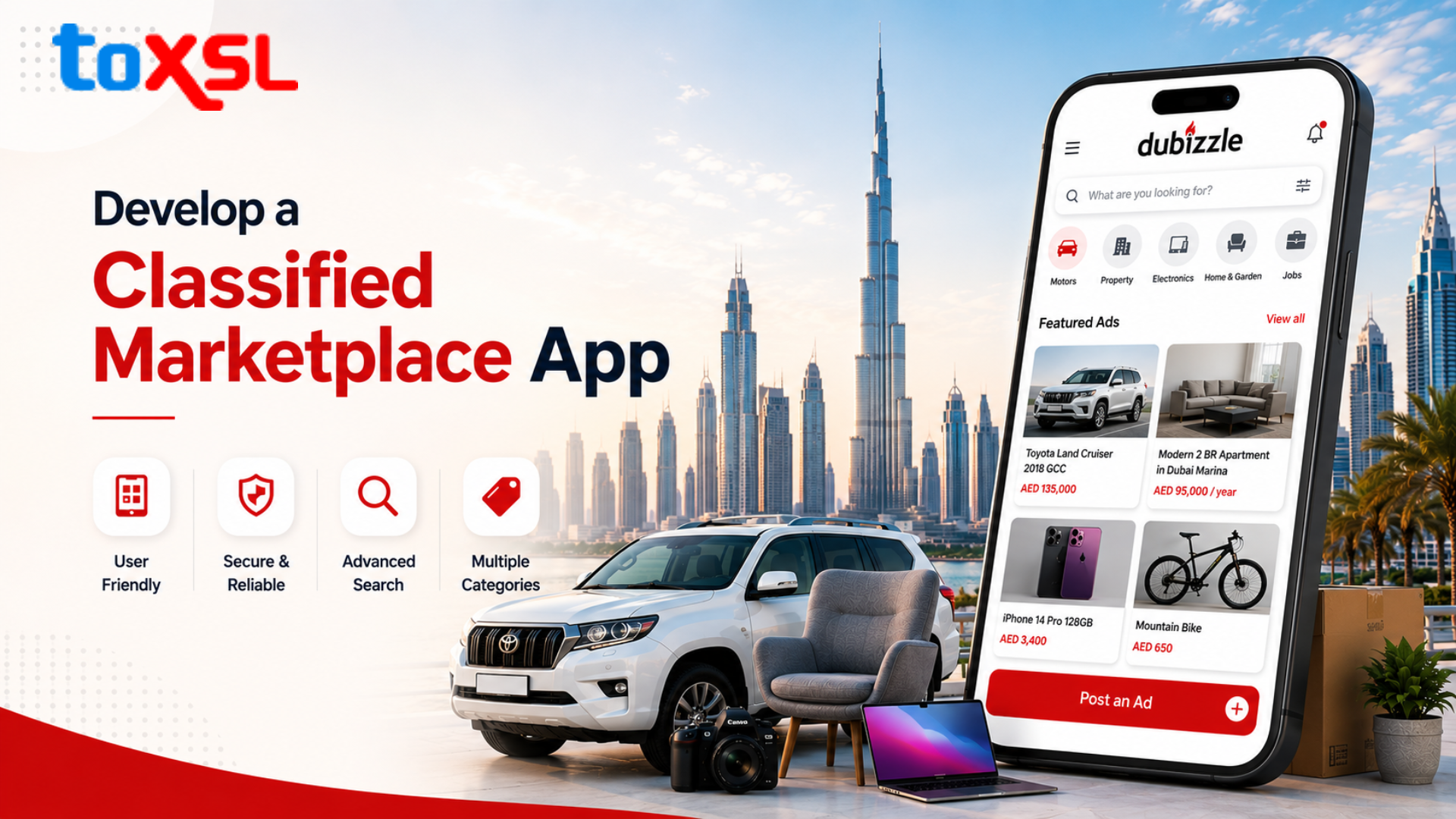
The Middle East and North Africa (MENA) digital advertising market is projected to grow to approximately $44.8 billion by 2032, highlighting the region’s rapid digital transformation and growing online economy. Increasing smartphone penetration, rising internet usage, and the expansion of mobile commerce are encouraging businesses and consumers to shift toward digital platforms for buying, selling, and service discovery.
With the growing demand for digital marketplaces in the MENA region, developing a classified marketplace app like Dubizzle presents a significant opportunity for startups, enterprises, and entrepreneurs looking to establish a strong digital presence and generate long-term revenue.
In this blog, we will discuss how to develop a classified marketplace app like Dubizzle in the Middle East, including its features, development process, cost estimation, revenue models, and factors affecting development costs. Let’s get started.
Key Takeaways
Classified marketplace apps are rapidly growing across the Middle East due to increasing digital adoption and mobile commerce.
Apps such as Dubizzle offer opportunities in multiple categories including real estate, vehicles, jobs, electronics, and services.
Essential features such as advanced search, secure payment integration, multilingual support, and chat systems improve user engagement.
Development costs depend on app complexity, features, platform selection, UI/UX design, and third-party integrations.
Revenue models like featured listings, subscriptions, advertisements, and commissions help businesses generate consistent income.
Why Are Classified Marketplace Apps Growing in the Middle East?
The Middle East digital economy is growing rapidly due to increased internet usage, mobile-first consumers, and rising digital transformation initiatives. Consumers now prefer online platforms because they provide convenience, better pricing options, and easy access to thousands of listings from a single application.
Several factors are contributing to the rapid growth of classified marketplace apps in the region:
High smartphone penetration rates
Growing digital payment adoption
Increased trust in online transactions
Rising demand for second-hand products
Growth in the real estate and automotive sectors
Expansion of freelance and service-based businesses
Government support for digital transformation
Growing eCommerce and mobile commerce markets
Countries like the UAE and Saudi Arabia have become major hubs for digital startups and online marketplace businesses. This creates a favorable environment for launching classified marketplace applications that cater to both local and international users.
Step-by-Step Development Process of Classified Marketplace App Like Dubizzle
Developing a classified marketplace app like Dubizzle requires careful planning, modern technologies, and a user-focused development approach. Businesses need to build a secure, scalable, and feature-rich platform that offers seamless buying and selling experiences across categories like real estate, vehicles, electronics, jobs, and services. From market research to deployment and maintenance, every development stage plays an important role in ensuring long-term marketplace success and profitability.
1. Conduct Market Research
The first stage of marketplace app development involves analyzing market trends, user expectations, and competitor strategies. Businesses must identify customer pain points, profitable categories, and regional demands to build a platform that stands out in the competitive marketplace industry while reducing development risks and improving business planning.
Key Research Areas:
Competitor analysis
Customer behavior
Market demand
Trending categories
Preferred payment methods
2. Define Business Model
Businesses should clearly define their goals, target audience, and revenue generation methods before starting development. A strong monetization strategy helps prioritize features, estimate project budgets, and create long-term profitability opportunities while ensuring the platform supports future business growth and user engagement.
Popular Revenue Models:
Featured listings
Subscription plans
Premium memberships
Advertisements
Commission-based earnings
3. Right Technology Stack
Selecting the right technology stack is essential for building a scalable and high-performing marketplace application. Businesses should use modern technologies that support real-time communication, cloud scalability, fast performance, secure transactions, and smooth user experiences across Android, iOS, and web platforms.
Common Technologies:
React Native
Flutter
Node.js
Laravel
MongoDB
AWS Cloud Services
4. Design User-Friendly UI/UX
A visually appealing and easy-to-use interface improves user engagement and retention. Businesses should focus on responsive layouts, smooth navigation, attractive listing pages, and fast-loading screens to ensure users can browse products, create listings, and complete transactions without confusion or delays.
Important UI/UX Elements:
Responsive design
Easy navigation
Fast search functionality
Attractive listing pages
Smooth onboarding process
5. Develop Core Marketplace Features
The development phase focuses on building essential functionalities such as user registration, product listing management, search systems, payment integration, and messaging features. These features help create smooth interactions between buyers and sellers while improving overall marketplace performance and customer satisfaction.
Core Features Include:
User authentication
Product listings
Search and filters
Real-time chat
Push notifications
Payment gateways
6. Integrate Security Systems
Security is crucial for custom mobile app development company because users share sensitive information and conduct online transactions. Businesses should implement encrypted communication systems, secure login methods, OTP verification, and fraud prevention tools to protect user data and build long-term customer trust.
Security Features:
SSL encryption
OTP verification
Secure login systems
Spam prevention
Fraud detection tools
7. Quality Assurance
Comprehensive testing ensures the application works efficiently across multiple devices, operating systems, and network conditions. Developers identify and resolve technical issues, performance problems, and security vulnerabilities before launch to provide users with a stable and seamless marketplace experience.
Types of Testing:
Functional testing
Security testing
Performance testing
Compatibility testing
UI/UX testing
8. Deploy, Maintain, and Scale
After testing, the application is deployed on app stores and cloud servers. Businesses must regularly monitor performance, release updates, improve security, and add advanced technologies like AI recommendations and chatbots to keep the marketplace competitive and improve long-term user engagement.
Post-Launch Activities:
App maintenance
Feature upgrades
Performance optimization
Security updates
Analytics monitoring
Customer support services
Features for Top Classified Marketplace Apps Like Dubizzle
The success of a classified marketplace application largely depends on the features it offers to buyers, sellers, and administrators. Modern users expect fast, secure, and user-friendly platforms that simplify the process of buying, selling, renting, and advertising products or services online.
A marketplace app like Dubizzle must provide advanced functionalities that improve user engagement, increase trust, simplify communication, and ensure seamless transactions. Businesses should focus on building feature-rich platforms that support multiple categories such as real estate, automobiles, electronics, jobs, furniture, and local services. Below are the essential features required for developing top Android App Development in Dubai.
1. User Registration
A simple and secure registration process is essential for attracting and retaining users. Customers should be able to sign up quickly using email addresses, phone numbers, or social media accounts. Profile management features allow users to manage personal details, track listings, monitor activities, and build credibility through verified profiles and account customization options.
Key Functionalities:
Email and mobile registration
Social media login integration
OTP verification
Profile editing and management
Saved listings and favorites
Account verification badges
2. Advanced Search
An advanced search system improves user experience by helping customers quickly find products or services that match their preferences. Smart filters reduce browsing time and make navigation more efficient by allowing users to sort listings based on categories, locations, pricing, and product conditions.
Popular Search Filters:
Location-based search
Category filters
Price range selection
Product condition
Date posted
Seller type
Brand filters
Keyword search
3. Product Listing System
The product listing system is one of the most important features of a classified marketplace app. Sellers should be able to create, edit, update, and manage listings easily while adding high-quality images, videos, descriptions, and pricing details to attract potential buyers and improve listing visibility.
Listing Features Include:
Multi-image uploads
Video upload support
Product descriptions
Category selection
Pricing management
Listing editing options
Draft saving feature
Listing expiration alerts
4. Real-Time Messaging System
Integrated messaging systems allow buyers and sellers to communicate instantly within the application. Real-time communication improves customer engagement, speeds up negotiations, and creates better user experiences by enabling direct interactions without requiring third-party messaging applications.
Messaging Features:
Instant messaging
Image sharing
Voice note support
Push message notifications
Chat history management
Read receipts
Typing indicators
5. Secure Payment Gateway Integration
Secure payment systems help users complete transactions safely within the marketplace application. Businesses should integrate trusted payment gateways that support multiple payment methods while ensuring transaction encryption, fraud prevention, and smooth checkout experiences for users across different regions.
Supported Payment Methods:
Credit cards
Debit cards
Digital wallets
Bank transfers
Cash-on-delivery
Buy-now-pay-later options
6. Multi-Language Support
Marketplace applications operating in the Middle East should support multiple languages and currencies to serve diverse customer groups effectively. Localization features improve accessibility, customer satisfaction, and user engagement while helping businesses expand across different countries and demographics.
Common Language Options:
Arabic
English
French
Urdu
7. Push Notifications
Push notifications keep users informed about new listings, promotional offers, chat messages, subscription renewals, and account activities. Timely alerts improve user engagement, increase return visits, and encourage users to respond quickly to marketplace opportunities and inquiries.
Notification Types:
New listing alerts
Chat message notifications
Promotional offers
Price drop alerts
Subscription reminders
Listing approval updates
8. Ratings and Review System
Ratings and reviews help build transparency and trust within the marketplace platform. Buyers can evaluate seller reliability, product quality, and customer service before making decisions, while sellers can improve their reputation through positive feedback and successful transactions.
Benefits of Reviews:
Improved seller credibility
Better customer trust
Reduced fraudulent activities
Higher engagement rates
Transparent marketplace
How Much Does it Cost to Develop Classified Marketplace App
Developing a classified marketplace app like Dubizzle involves multiple stages, including market research, UI/UX design, backend development, feature integration, testing, deployment, and maintenance. The total development cost depends on factors such as app complexity, number of features, technology stack, supported platforms, and third-party integrations. A basic marketplace app with essential features costs less, while advanced applications with AI recommendations, multilingual support, secure payment gateways, and real-time chat systems require a higher investment. Businesses should also consider post-launch expenses like maintenance, cloud hosting, security updates, and feature enhancements for long-term marketplace growth and scalability.
Development Component | Estimated Cost |
|---|---|
Market Research & Planning | $3,000 – $8,000 |
UI/UX Design | $5,000 – $15,000 |
Frontend Development | $10,000 – $25,000 |
Backend Development | $10,000 – $30,000 |
User Authentication System | $2,000 – $5,000 |
Product Listing Management | $4,000 – $10,000 |
Search & Filter Integration | $3,000 – $8,000 |
Real-Time Chat System | $4,000 – $12,000 |
Payment Gateway Integration | $3,000 – $10,000 |
Multi-Language Support | $2,000 – $6,000 |
Admin Dashboard Development | $5,000 – $12,000 |
Security & Fraud Prevention | $3,000 – $8,000 |
Testing & Quality Assurance | $5,000 – $12,000 |
App Store Deployment | $1,000 – $3,000 |
Cloud Hosting & Infrastructure | $2,000 – $8,000 |
Annual Maintenance & Updates | 15%–20% of Total Development Cost |
Total Estimated Cost | $40,000 – $150,000+ |
Factors Affecting Classified Marketplace App Development Cost
The cost of developing a classified marketplace application like Dubizzle depends on multiple technical, design, and business-related factors. Every feature, integration, and customization requirement directly impacts the overall project budget and development timeline. Businesses planning to build a marketplace app must carefully evaluate these factors to estimate costs accurately and create a scalable development strategy.
1. App Complexity
The complexity of the marketplace application significantly affects development costs. Basic apps with limited functionalities cost less, while advanced applications with AI recommendations, real-time chat, multilingual support, analytics dashboards, and secure payment systems require more development time, testing, and technical expertise.
2. Platform Selection
3. UI/UX Design Complexity
A visually appealing and user-friendly interface requires additional design effort and development time. Custom animations, interactive layouts, responsive screens, and smooth navigation systems improve user experiences but increase the total marketplace app development cost.
4. Technology Stack Used
The technologies selected for frontend, backend, database management, and cloud infrastructure influence development costs and app performance. Modern and scalable technologies ensure better security, flexibility, and future scalability but may require experienced developers and higher investment.
5. Third-Party API and Service Integrations
Integrating third-party services such as payment gateways, maps, social media logins, analytics tools, and messaging systems increases development complexity and expenses. These integrations improve platform functionality and user convenience but require additional testing and maintenance.
Classified Marketplace App: Revenue Models
A classified marketplace application like Dubizzle can become a highly profitable digital business when supported by the right monetization strategies. Revenue models play an important role in ensuring long-term sustainability, platform scalability, and continuous business growth. A well-planned monetization strategy helps marketplace owners generate recurring income while improving user engagement and seller participation. Below are some of the most effective revenue models for classified marketplace applications.
1. Featured Listings
Featured listings are one of the most popular revenue models used in marketplace applications. Sellers pay additional fees to place their advertisements at the top of search results, category pages, or homepage sections. These highlighted listings receive greater visibility, attract more customer attention, and increase the chances of faster sales and higher engagement. This monetization strategy benefits both sellers and marketplace owners. Sellers gain better exposure for their products or services, while businesses generate recurring revenue from promotional advertisement placements.
2. Subscription Plans
Subscription plans allow businesses, agencies, dealers, and professional sellers to access premium marketplace features through monthly, quarterly, or yearly payment packages. This model creates stable and recurring revenue streams while encouraging long-term user retention and customer loyalty. Professional users often require additional features such as unlimited listings, advanced analytics, priority customer support, and enhanced advertisement visibility.3. In-App Advertisements
In-app advertising is another highly effective monetization strategy for classified marketplace applications. Businesses can display banner ads, sponsored content, pop-up promotions, and targeted advertisements from third-party companies looking to reach marketplace users.
Marketplace apps with high user engagement and traffic become valuable advertising platforms for brands and service providers.
4. Commission-Based Revenue Model
The commission-based revenue model allows marketplace owners to charge a percentage fee for every successful transaction completed through the platform. This model is highly effective for industries such as property rentals, automotive sales, freelancing services, and online bookings. Instead of charging upfront fees, businesses earn revenue whenever users successfully buy, sell, rent, or book services through the application.
5. Premium Membership Plans
Premium memberships offer exclusive features and enhanced marketplace experiences for users willing to pay additional fees. These plans are designed for users who want advanced tools, better visibility, and improved platform functionality.
Premium users often receive benefits such as ad-free browsing, faster listing approvals, highlighted profiles, advanced search options, and increased listing limits. This revenue model helps businesses improve customer retention while generating consistent recurring income.
6. Sponsored Ads and Promotional Campaigns
Sponsored advertisements allow sellers and businesses to promote products or services directly within the marketplace application. Sponsored campaigns improve product visibility, attract targeted audiences, and increase lead generation opportunities for sellers. Marketplace owners can offer different promotional packages based on campaign duration, advertisement placement, and audience targeting options.
Conclusion
The growing digital economy in the Middle East has increased the demand for classified marketplace applications like Dubizzle. Businesses are investing in feature-rich platforms that simplify buying, selling, renting, and service discovery while offering secure and seamless user experiences. Developing a successful marketplace app requires scalable technology, advanced features, strong security, and user-friendly design. Businesses must also focus on long-term scalability and customer engagement to stay competitive in the evolving digital market.
At ToXSL Technologies, a leading software development company, we specialize in developing secure, scalable, and customized classified marketplace applications tailored to modern business needs. Our expert team helps businesses build high-performing digital platforms that drive growth, engagement, and long-term success. Hire Android App Developers in Dubai with us.
Frequently Asked Questions
1. What is a classified marketplace app?
A classified marketplace app is an online platform where users can buy, sell, rent, or advertise products and services across multiple categories such as real estate, automobiles, jobs, electronics, furniture, and local services. These platforms connect buyers and sellers while simplifying transactions and communication.
2. How long does it take to develop a classified marketplace app?
The development timeline depends on app complexity, features, design requirements, and platform selection. A basic marketplace application may take a few months, while advanced platforms with AI features, payment systems, and multilingual support require longer development and testing cycles.
3. What are the essential features of a marketplace app like Dubizzle?
A successful iOS App Development company in Dubai should include features such as user registration, product listing management, advanced search filters, real-time messaging, secure payment integration, push notifications, multilingual support, and admin dashboards to improve user engagement and platform management.
Important Features Include:
User authentication
Product listings
Search and filter systems
Real-time chat
Payment gateway integration
Ratings and reviews
4. How much does it cost to develop a classified marketplace app?
The cost of developing a classified marketplace application depends on app complexity, feature requirements, technology stack, design customization, and development team expertise. Basic marketplace apps cost less, while advanced applications with AI and automation require higher investment.
Cost Factors Include:
App complexity
Number of features
UI/UX design
Technology stack
Third-party integrations
5. How do classified marketplace apps generate revenue?
Marketplace applications generate revenue through multiple monetization strategies such as featured listings, subscription plans, premium memberships, in-app advertisements, sponsored promotions, lead generation charges, and transaction-based commission models depending on the business structure and target audience.Popular Revenue Models:
Featured advertisements
Subscription plans
Commission-based earnings
Sponsored promotions
Premium memberships
6. Why choose ToXSL Technologies for marketplace app development?
ToXSL Technologies provides customized, scalable, and secure marketplace app development solutions tailored to business goals and industry requirements. Our experienced developers focus on delivering feature-rich applications with modern technologies, seamless user experiences, and long-term technical support.
Why Businesses Choose ToXSL Technologies:
Experienced development team
Scalable app solutions
Advanced technology expertise
End-to-end development services
Ongoing maintenance and support