Key Takeaways
- Fitness wearable apps connect smartphones with smartwatches, fitness bands, rings, and other connected health devices.
- Dubai offers strong opportunities for fitness technology because of its digitally focused and innovation-driven market.
- Core features can include activity tracking, heart-rate monitoring, workout management, notifications, analytics, and wearable synchronization.
- Development costs depend on app complexity, wearable integrations, UI/UX, backend infrastructure, security, and advanced technologies.
- A successful development process begins with business planning and continues through design, development, testing, deployment, and maintenance.
- AI, predictive analytics, voice technology, and personalized recommendations are expected to shape future wearable applications.
- Choosing an experienced fitness wearable app development company can help businesses create secure, scalable, and user-friendly solutions.
Dubai is rapidly becoming a hub for digital innovation, smart healthcare, and technology-driven fitness experiences. With increasing interest in connected devices, personalized wellness, and real-time health tracking, fitness wearable apps are creating new opportunities for gyms, healthcare providers, fitness brands, startups, and enterprises.
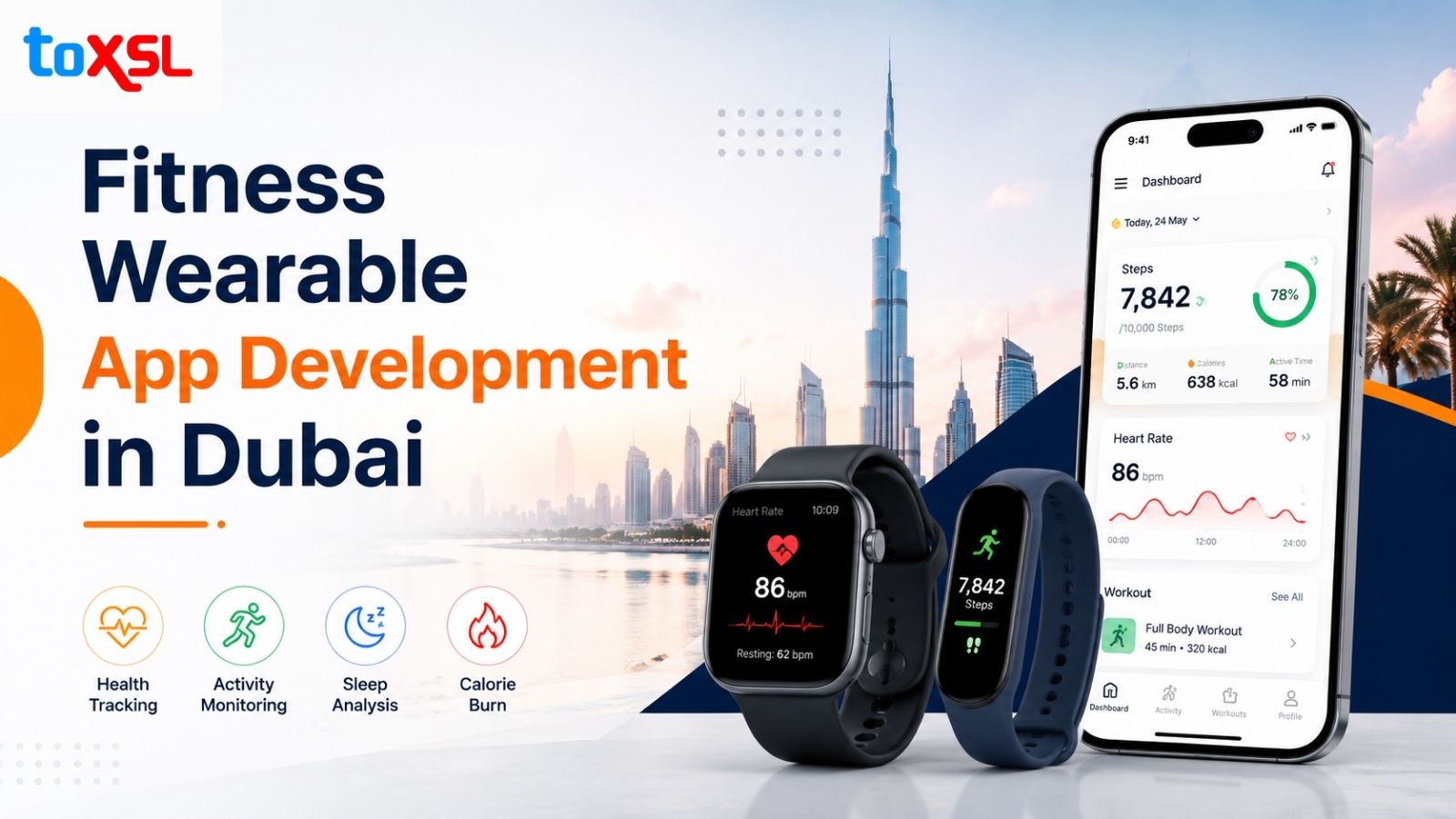
A fitness wearable app connects smartwatches, fitness bands, smart rings, and other connected devices with mobile or cloud-based applications. These solutions can collect and analyze information such as steps, calories, heart rate, workouts, sleep patterns, and activity levels.
For businesses in Dubai, developing a fitness wearable app can provide a powerful way to engage users, deliver personalized experiences, and build recurring digital services. However, successful development requires more than attractive interfaces. It involves device integration, secure data management, analytics, cloud infrastructure, intuitive UX, and scalable technology.
This guide explores the development process, essential features, benefits, estimated cost, major cost factors, and future opportunities associated with fitness wearable app development in Dubai.
Why Invest in Fitness Wearable App Development in Dubai?
Dubai's technology ecosystem creates significant opportunities for businesses entering the fitness and wellness technology market. Wearable applications can help organizations establish stronger digital engagement while collecting meaningful activity insights.
From fitness centers and personal trainers to healthcare organizations and wellness startups, businesses can use wearable technology to create connected experiences. Integration with smart devices can also enable continuous engagement instead of limiting interactions to occasional visits or sessions.
For businesses targeting Dubai's digitally connected consumers, a well-designed wearable app can become an important part of a broader fitness, wellness, or healthcare ecosystem.
Development Process: From Fitness App Concept to Connected Wearable Platform
Developing a fitness wearable application requires a structured approach that combines business planning, mobile development, wearable integration, cloud technology, data security, and testing. Each stage should be aligned with the target audience and business objectives to create a reliable, scalable, and engaging digital fitness experience.
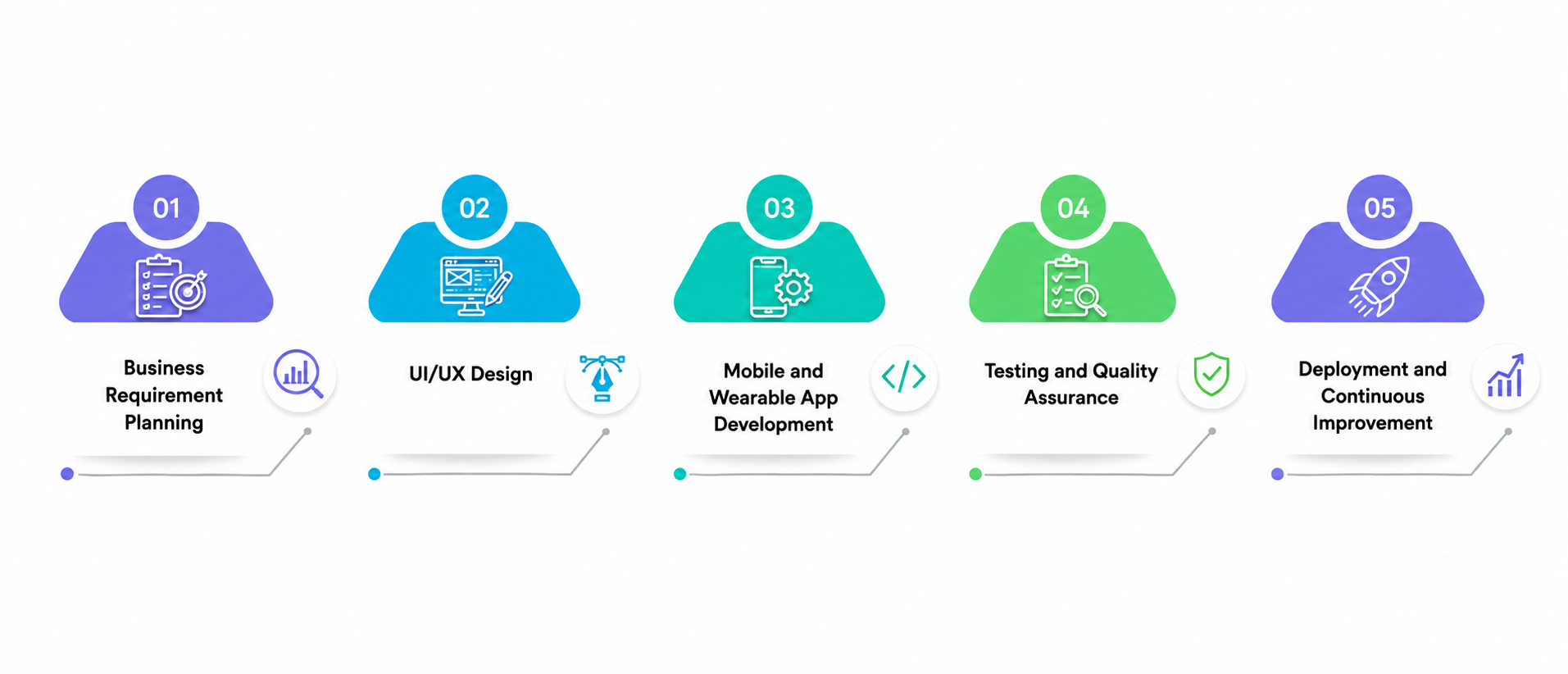
1. Business Requirement Planning
The first stage involves understanding the business model, target users, supported wearable devices, required integrations, and application objectives. The app development team defines the MVP scope, technical requirements, user journeys, and expected outcomes before development begins. This planning helps minimize unnecessary development work and establishes a clear project roadmap.
- Identify target users and their fitness requirements.
- Define wearable devices and platforms to support.
- Establish essential MVP features.
- Prepare technical and functional specifications.
2. UI/UX Design
The design stage focuses on creating simple, engaging, and accessible experiences across mobile and wearable screens. Fitness information must be easy to understand at a glance, particularly when users are exercising. Designers develop wireframes, navigation structures, dashboards, prototypes, and visual interfaces while maintaining consistency between wearable and smartphone experiences.
- Create intuitive navigation and user flows.
- Design mobile and wearable-specific interfaces.
- Develop interactive prototypes.
- Prioritize accessibility and usability.
3. Mobile and Wearable App Development
Developers transform approved designs into functional applications using appropriate technologies for iOS, Android, and wearable platforms. Device APIs and SDKs are integrated to collect relevant activity information. Backend services are also developed to process, synchronize, store, and securely deliver data between wearable devices and applications.
- Develop iOS and Android applications.
- Integrate wearable APIs and SDKs.
- Build secure backend services.
- Implement real-time data synchronization.
4. Testing and Quality Assurance
Comprehensive testing ensures that the application performs reliably across supported devices, operating systems, network conditions, and user scenarios. Testing teams evaluate synchronization, notifications, data accuracy, performance, security, usability, and battery efficiency. Real-device testing is particularly important because wearable behavior can differ across manufacturers and operating environments.
- Perform functional and usability testing.
- Test wearable-device synchronization.
- Evaluate application performance and security.
- Resolve bugs before deployment.
5. Deployment and Continuous Improvement
After successful testing, the application is prepared for deployment through relevant app stores and wearable ecosystems. However, development does not end at launch. Performance monitoring, user feedback, security updates, compatibility improvements, and new feature releases help maintain long-term application quality and competitiveness in Dubai's evolving digital market.
- Deploy applications to relevant platforms.
- Monitor performance and user engagement.
- Release security and compatibility updates.
- Continuously improve features based on feedback.
Benefits of Developing a Fitness Wearable App in Dubai
Fitness wearable applications can deliver value to both businesses and users by connecting everyday physical activity with digital services. They enable continuous engagement, personalized experiences, valuable insights, and convenient access to fitness information. For businesses, these capabilities can support stronger customer relationships, differentiated services, and new digital revenue opportunities.
1. Continuous User Engagement
Wearable applications remain connected to users throughout their daily routines, creating more opportunities for interaction than traditional fitness applications. Notifications, goals, progress updates, and personalized recommendations can encourage users to remain active. This continuous connection can help businesses build stronger engagement and improve long-term retention.
- Send personalized activity reminders.
- Track progress toward fitness goals.
- Provide achievement notifications.
- Encourage consistent user participation.
2. Personalized Fitness Experiences
Wearable devices generate valuable activity information that applications can use to personalize experiences. Based on user preferences and activity patterns, businesses can deliver customized workouts, goals, reminders, and recommendations. Personalization can make fitness applications more relevant while helping users better understand their progress.
- Create personalized fitness goals.
- Recommend suitable workouts.
- Customize reminders and notifications.
- Display individual progress insights.
3. Data-Driven Business Insights
Aggregated and appropriately managed application data can help businesses understand engagement patterns, popular features, workout preferences, and user behavior. These insights can support better product decisions and service improvements. Businesses can use analytics to identify opportunities for engagement while maintaining appropriate privacy and data-management practices.
- Analyze user engagement patterns.
- Identify popular application features.
- Measure retention and activity trends.
- Support data-informed product decisions.
4. New Revenue Opportunities
A wearable fitness platform can support multiple business models, including premium subscriptions, personalized training packages, digital wellness programs, partnerships, and premium analytics. Businesses can design monetization strategies around their target market while continuously introducing valuable services that encourage customers to remain engaged with the platform.
- Offer premium subscription plans.
- Introduce personalized training services.
- Create advanced analytics packages.
- Develop business and wellness partnerships.
Essential Features for a Modern Fitness Wearable App
The right feature set determines how effectively a wearable application serves users and business objectives. A modern solution should combine reliable activity tracking with intuitive dashboards, synchronization, notifications, analytics, personalization, and security. Advanced applications can further incorporate AI-driven recommendations and integrations with broader digital health and fitness ecosystems.
1. Activity and Fitness Tracking
Activity tracking is a fundamental component of wearable applications. Depending on device capabilities, the app can capture information such as steps, distance, calories, active minutes, workouts, and other fitness metrics. Presenting this information through clear dashboards helps users understand their daily activity and monitor progress.
2. Heart Rate and Health Metrics
Supported wearable devices can provide access to different health-related measurements through approved device APIs and platform capabilities. The application can organize available information into easy-to-understand dashboards. Health-related functionality should be designed carefully, with appropriate privacy, security, consent, and regulatory considerations.
3. Workout Management
Workout functionality enables users to start, monitor, pause, and review exercise sessions. Applications can support different workout categories and display relevant metrics during or after an activity. Trainers and fitness businesses can also use workout functionality to create structured programs and improve user engagement.
4. Sleep and Recovery Tracking
Where supported by connected devices, sleep functionality can provide insights into sleep duration, patterns, and recovery-related information. Presenting these trends alongside activity data can provide users with a broader view of their wellness routines and help them understand how daily habits relate to overall fitness.
5. Real-Time Notifications
Notifications can keep users informed about goals, workout progress, reminders, achievements, and other relevant events. Wearable-specific notifications should be concise and unobtrusive so users can understand them quickly. Businesses can also use notifications to support engagement campaigns and personalized interactions.
6. Analytics and Progress Dashboard
A centralized dashboard can transform raw activity data into meaningful visual insights. Charts, trends, comparisons, and historical summaries allow users to understand their progress more easily. Businesses can also provide premium analytics that offer deeper insights for athletes, trainers, wellness programs, or enterprise customers.
7. Wearable and Third-Party Integrations
Integration capabilities allow the application to connect with supported smartwatches, fitness bands, smart rings, smartphones, and health platforms. Depending on business requirements, developers may integrate platform services and device APIs to synchronize relevant information while maintaining data security and compatibility across supported ecosystems.
Fitness Wearable App Development Cost in Dubai
The cost of developing a fitness wearable application in Dubai depends heavily on its functionality, supported platforms, wearable integrations, design complexity, backend architecture, and development team. A basic application with limited tracking can require significantly less investment than an advanced platform incorporating AI, multiple wearable ecosystems, real-time analytics, and enterprise functionality.
Development Level | Typical Features | Estimated Cost in Dubai |
Basic | Activity tracking, profiles, notifications, basic dashboards | AED 60,000–100,000 |
Medium | Wearable integration, workout tracking, analytics, cloud backend | AED 100,000–180,000 |
Advanced | Multiple devices, advanced analytics, subscriptions, AI features | AED 180,000–300,000+ |
Enterprise | Advanced integrations, scalable infrastructure, custom dashboards, security, AI | AED 300,000–500,000+ |
What Determines the Cost of Fitness Wearable App Development?
The final fitness app development cost is influenced by several technical and business variables. Understanding these factors early can help businesses create realistic budgets and prioritize their MVP. A clear feature roadmap can also prevent unnecessary complexity during the initial development stage while leaving room for future upgrades and integrations.
1. App Complexity
The number and sophistication of features directly influence development effort. A basic activity tracker requires less engineering than a platform with personalized workouts, subscriptions, advanced analytics, AI recommendations, multiple user roles, and enterprise dashboards. Businesses should prioritize essential functionality for the first release before adding advanced capabilities.
2. Wearable Device Integration
Supporting multiple wearable brands can increase development and testing requirements. Each ecosystem may provide different APIs, SDKs, permissions, synchronization mechanisms, and technical limitations. Businesses should identify priority devices based on their target audience rather than attempting to support every wearable platform from the beginning.
3. Platform Selection
Developing for iOS, Android, and wearable operating systems can affect both development time and cost. Cross-platform technologies may reduce certain development efforts, while native development can provide deeper platform-specific capabilities. The right approach depends on performance requirements, integrations, target devices, and the desired user experience.
4. UI/UX Design
A sophisticated interface with personalized dashboards, animations, interactive charts, wearable-specific screens, and custom branding requires additional design and development work. Fitness applications should prioritize simplicity because users frequently interact with them while exercising. Investing in thoughtful UX can improve usability, engagement, and overall product quality.
5. Backend and Cloud Infrastructure
Wearable applications often require secure backend systems for authentication, synchronization, analytics, notifications, and data storage. As user numbers grow, infrastructure must scale efficiently. Cloud architecture, APIs, databases, real-time services, backup systems, and monitoring can therefore have a significant effect on overall development and operational costs.
6. Security and Compliance
Fitness and health applications may process sensitive personal information, making security a critical consideration. Encryption, secure authentication, access controls, consent mechanisms, data retention policies, and secure API communication may be required. The exact compliance requirements depend on the application's functionality, market, data practices, and applicable regulations.
7. AI and Advanced Analytics
AI-powered recommendations, predictive analytics, intelligent workout planning, conversational assistants, and personalized insights can increase development complexity. These capabilities may require machine-learning models, data pipelines, cloud computing, specialized APIs, and continuous optimization. Businesses should evaluate whether AI provides meaningful value before incorporating it into the initial product.
The Future of Fitness Wearable Apps: Smarter, More Personalized, More Connected
The wearable technology ecosystem is moving toward increasingly intelligent and connected fitness experiences. Future applications are likely to focus on personalization, predictive insights, seamless device connectivity, and AI-assisted experiences. Businesses that build flexible platforms today can prepare for emerging technologies while continuously improving user engagement and service capabilities.
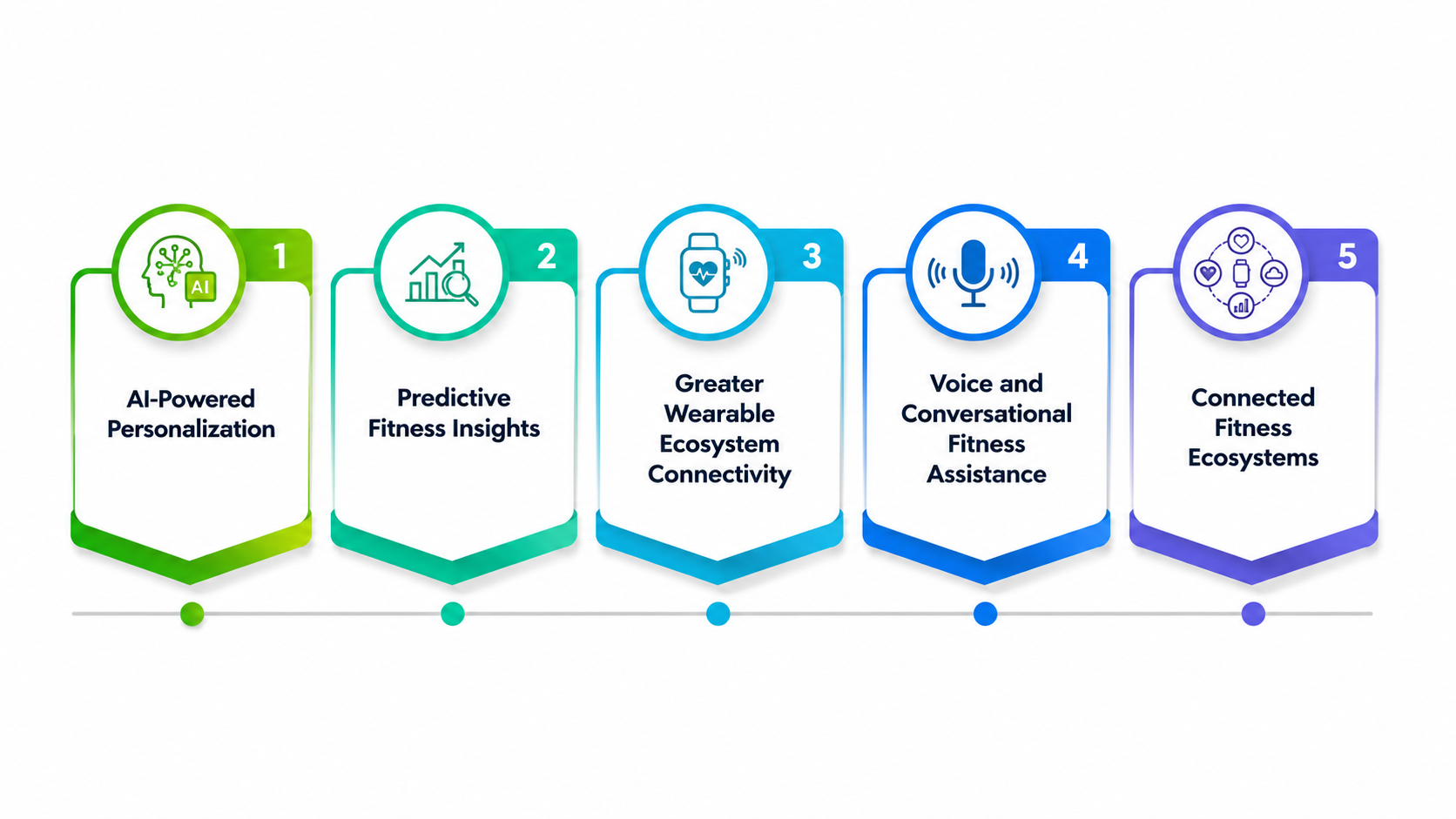
1. AI-Powered Personalization
AI can analyze activity patterns and user preferences to generate more personalized fitness experiences. Future applications may provide adaptive recommendations that respond to changing activity levels, goals, and routines. Instead of presenting identical programs to every user, intelligent systems can increasingly deliver experiences tailored to individual needs.
2. Predictive Fitness Insights
Advanced analytics can help applications identify patterns within historical activity data and generate predictive insights. Future platforms may use these capabilities to identify changes in routines, recommend adjustments, and provide proactive wellness guidance. Such functionality can make wearable applications more useful than simple data-collection tools.
3. Greater Wearable Ecosystem Connectivity
As consumers adopt multiple connected devices, fitness platforms will increasingly need to work across broader ecosystems. Future applications may bring information from smartwatches, rings, fitness equipment, connected scales, and other devices into unified dashboards, creating a more comprehensive view of activity and wellness.
4. Voice and Conversational Fitness Assistance
Voice technology and conversational AI can make fitness applications more interactive. Users may increasingly access workout guidance, progress summaries, reminders, and fitness information through natural language interfaces. This can reduce dependence on complex menus and provide more convenient experiences across smartphones and compatible wearable devices.
5. Connected Fitness Ecosystems
The future of wearable technology extends beyond individual applications. Fitness platforms can increasingly connect users, trainers, gyms, healthcare providers, wellness programs, and connected devices within broader digital ecosystems. This interconnected approach can create new services and business models while delivering more continuous and personalized experiences.
Conclusion
Fitness wearable applications are becoming an important part of the rapidly evolving digital fitness and wellness ecosystem. For businesses in Dubai, these solutions can create new opportunities to engage users, personalize services, collect meaningful insights, and develop innovative digital revenue models.
From activity tracking and wearable synchronization to analytics, AI-powered personalization, and connected fitness ecosystems, the possibilities continue to expand. However, successful development requires careful planning, reliable technology, strong security, intuitive UX, and a scalable architecture.
As a leading fitness wearable app development company in UAE, ToXSL Technologies helps businesses transform fitness concepts into modern, connected digital solutions. With expertise in mobile applications, wearable integrations, cloud technologies, AI, and custom software development, ToXSL Technologies can help businesses build fitness platforms designed for performance, scalability, and long-term growth.
Frequently Asked Questions
1. How long does it take to develop a fitness wearable app?
A basic application may take around 3–5 months, while medium and advanced solutions can require 5–9 months or longer. The timeline depends on the number of features, supported devices, integrations, testing requirements, and customization.
2. Which wearable devices can be integrated with a fitness app?
Depending on the project requirements, applications can integrate with supported smartwatches, fitness bands, smart rings, smartphones, connected fitness equipment, and health platforms through available APIs and SDKs.
3. Can AI be integrated into a fitness wearable application?
Yes. AI can support personalized workout recommendations, activity insights, conversational fitness assistance, predictive analytics, user segmentation, intelligent notifications, and other customized experiences.
4. Should I develop an iOS and Android fitness wearable app?
Supporting both platforms can help businesses reach a broader audience. However, the ideal approach depends on the target users, wearable ecosystem, budget, required integrations, and business objectives.
5. How can a fitness wearable app generate revenue?
Common monetization models include subscriptions, premium features, personalized fitness programs, trainer services, enterprise wellness programs, partnerships, and advanced analytics packages.
6. Why choose ToXSL Technologies for fitness wearable app development?
ToXSL Technologies combines expertise in mobile app development, wearable integrations, AI, cloud solutions, UI/UX, and custom software development to create scalable digital fitness solutions. The team can support businesses from initial planning and design through development, testing, deployment, and ongoing improvements.